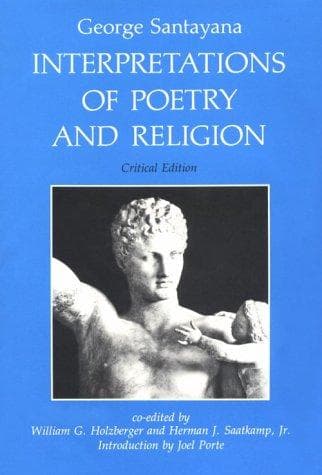
Interpretations of Poetry and ReligionSantayana, George
Religion
Interpretations of Poetry and Religion
Santayana, George
Aesthetics; Literature -- History and criticism; Poetry; Religion
On the other hand, the positivistic school of criticism would seem, if
our theory is right, to have overlooked in its programme the highest
functions of human nature. The environing world can justify itself to
the mind only by the free life which it fosters there. All observation
is observation of brute fact, all discipline is mere repression, until
these facts digested and this discipline embodied in humane impulses
become the starting-point for a creative movement of the imagination,
the firm basis for ideal constructions in society, religion, and art.
Only as conditions of these human activities can the facts of nature
and history become morally intelligible or practically important. In
themselves they are trivial incidents, gossip of the Fates, cacklings
of their inexhaustible garrulity. To regard the function of man as
accomplished when these chance happenings have been recorded by him or
contributed to by his impulsive action, is to ignore his reason, his
privilege,--shared for the rest with every living creature,--of using
Nature as food and substance for his own life. This human life is not
merely animal and passionate. The best and keenest part of it consists
in that very gift of creation and government which, together with all
the transcendental functions of his own mind, man has significantly
attributed to God as to his highest ideal. Not to see in this rational
activity the purpose and standard of all life is to have left human
nature half unread. It is to look to the removal of certain incidental
obstacles in the work of reason as to the solution of its positive
tasks. In comparison with such apathetic naturalism, all the errors
and follies of religion are worthy of indulgent sympathy, since they
represent an effort, however misguided, to interpret and to use the
materials of experience for moral ends, and to measure the value of
reality by its relation to the ideal.
The moral function of the imagination and the poetic nature of religion
form, then, the theme of the following pages. It may not be amiss to
announce it here, as the rather miscellaneous subjects of these essays
might at first sight obscure the common import of them all.
CONTENTS
I. UNDERSTANDING, IMAGINATION, AND MYSTICISM
II. THE HOMERIC HYMNS
III. THE DISSOLUTION OF PAGANISM
IV. THE POETRY OF CHRISTIAN DOGMA
V. PLATONIC LOVE IN SOME ITALIAN POETS
VI. THE ABSENCE OF RELIGION IN SHAKESPEARE
VII. THE POETRY OF BARBARISM
VIII. EMERSON
IX. A RELIGION OF DISILLUSION
X. THE ELEMENTS AND FUNCTION OF POETRY
I
UNDERSTANDING, IMAGINATION, AND MYSTICISM
Public-domain text, read in full here on John Shaqi.
Reviews
Reviews
No reviews yet
Be the first to share your thoughts on this work.
Join the Discussion
Join the discussion
Sign in to leave a comment or review.
Sign InorCreate an account