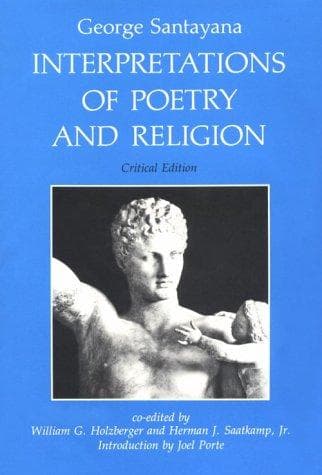
Interpretations of Poetry and ReligionSantayana, George
Religion
Interpretations of Poetry and Religion
Santayana, George
Aesthetics; Literature -- History and criticism; Poetry; Religion
When we consider the situation of the human mind in Nature, its limited
plasticity and few channels of communication with the outer world, we
need not wonder that we grope for light, or that we find incoherence
and instability in human systems of ideas. The wonder rather is that we
have done so well, that in the chaos of sensations and passions that
fills the mind, we have found any leisure for self-concentration and
reflection, and have succeeded in gathering even a light harvest of
experience from our distracted labours. Our occasional madness is less
wonderful than our occasional sanity. Relapses into dreams are to be
expected in a being whose brief existence is so like a dream; but who
could have been sure of this sturdy and indomitable perseverance in the
work of reason in spite of all checks and discouragements?
The resources of the mind are not commensurate with its ambition. Of
the five senses, three are of little use in the formation of permanent
notions: a fourth, sight, is indeed vivid and luminous, but furnishes
transcripts of things so highly coloured and deeply modified by the
medium of sense, that a long labour of analysis and correction is
needed before satisfactory conceptions can be extracted from it. For
this labour, however, we are endowed with the requisite instrument.
We have memory and we have certain powers of synthesis, abstraction,
reproduction, invention,--in a word, we have understanding. But this
faculty of understanding has hardly begun its work of deciphering the
hieroglyphics of sense and framing an idea of reality, when it is
crossed by another faculty--the imagination. Perceptions do not remain
in the mind, as would be suggested by the trite simile of the seal
and the wax, passive and changeless, until time wear off their sharp
edges and make them fade. No, perceptions fall into the brain rather
as seeds into a furrowed field or even as sparks into a keg of powder.
Each image breeds a hundred more, sometimes slowly and subterraneously,
sometimes (when a passionate train is started) with a sudden burst of
fancy. The mind, exercised by its own fertility and flooded by its
inner lights, has infinite trouble to keep a true reckoning of its
outward perceptions. It turns from the frigid problems of observation
to its own visions; it forgets to watch the courses of what should be
its "pilot stars." Indeed, were it not for the power of convention in
which, by a sort of mutual cancellation of errors, the more practical
and normal conceptions are enshrined, the imagination would carry men
wholly away,--the best men first and the vulgar after them. Even as it
is, individuals and ages of fervid imagination usually waste themselves
in dreams, and must disappear before the race, saddened and dazed,
perhaps, by the memory of those visions, can return to its plodding
thoughts.
Public-domain text, read in full here on John Shaqi.
Reviews
Reviews
No reviews yet
Be the first to share your thoughts on this work.
Join the Discussion
Join the discussion
Sign in to leave a comment or review.
Sign InorCreate an account