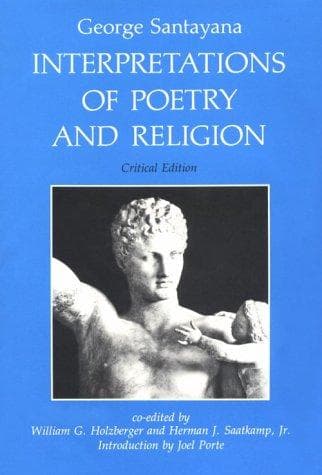
Interpretations of Poetry and ReligionSantayana, George
Religion
Interpretations of Poetry and Religion
Santayana, George
Aesthetics; Literature -- History and criticism; Poetry; Religion
The mysteries, on the other hand, had essentially a spirit of
self-consciousness and propaganda. They came as revelations or as
reforms; they pretended to disclose secrets handed down from remote
antiquity, from the primeval revelation of God to man, or truths
recovered by the inspiration of later prophets supernaturally
illumined. The history of these movements is, accordingly, the
history-of sects. They never constituted the normal and common religion
of the people, and never impressed their spirit on the national
literature. Æschylus or Plato may have borrowed something from them;
but they did so most when they assumed an attitude of open opposition
to the exoteric religion of their country. Thus when Plato makes his
Socrates propound a Pythagorean or Orphic doctrine of transmigration,
he represents the very members of the Socratic circle as surprised,
or as incredulous: and when they are finally silenced by the proofs
advanced, it is only because they are overawed by the dogmatic unction
of a dying sage, who stimulates their imagination with poetic myths,
and confuses their intellect with verbal equivocations. When the mist
of the argument has cleared away, like incense after the sacrifice,
there remains indeed a profound emotion, a catharsis produced by the
sublimity and pathos, so artfully mingled, of both scene and argument;
but the bare doctrine enunciated, true and profound as it is in its
deeper meaning, is quite incapable of appealing to an undisciplined
mind, and could not pass for a religious dogma except for the priestly
robes in which it is dressed. Thus the function of the mysteries
of which Plato's Phædo may be regarded as a philosophic echo, was
to be the vehicle of revolutionary tendencies, tendencies which a
philosopher might privately shape in one way and a superstitious man in
another. Both could find in the spell of an occult ceremonial and in
the prophecies of an oracular creed an escape from the limitations of
the official religion. Mysticism and the claim to illumination found
in these mysteries their natural expression. The many fundamental
questions left unanswered and unasked by Paganism, the many
potentialities of religious emotion left unexercised by it, were thus
allowed to appear.
Public-domain text, read in full here on John Shaqi.
Reviews
Reviews
No reviews yet
Be the first to share your thoughts on this work.
Join the Discussion
Join the discussion
Sign in to leave a comment or review.
Sign InorCreate an account