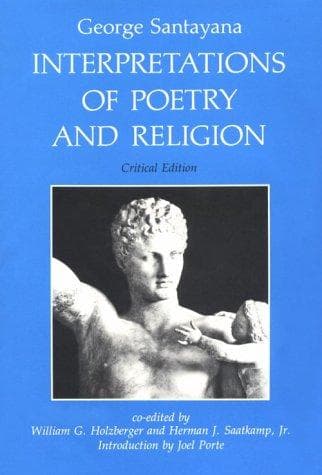
Interpretations of Poetry and ReligionSantayana, George
Religion
Interpretations of Poetry and Religion
Santayana, George
Aesthetics; Literature -- History and criticism; Poetry; Religion
Independently of these two comparatively silent streams of religious
life, we may trace the current of polytheistic theology,--a current
which naturally left a plainer trace in literature, since it contained
all there might be in Greece of speculation and controversy in
religious matters. The moral sanctions of religion were embodied in the
domestic and civic worship; the pious imagination remained thereby all
the freer to follow the analogies of physical objects in its mythology.
Apollo was the father of Asclepius and the leader of the Muses; his
ideal dignity and beneficence were vouched for by those attributes.
He could well afford, therefore, as the Sun-god, to decimate the
Greek army with the same fatal shafts with which he slew the Python.
The moral function of the god was certain on other grounds, being
enshrined in the local religions of the people. The poet might follow
without scruple the suggestions of experience; he might attribute to
the god the various activities, beneficent and maleficent, observable
in the element over which he presided. This is a liberty taken even
in the most moralistic religions. In the Gospels, for instance, we
sometimes find the kingdom of heaven illustrated by principles drawn
from observation of this world rather than from an ideal conception of
justice; as when we hear that to him that hath shall be given and from
him that hath not shall be taken away even that which he hath. Such
characterizations appeal to our sense of fact. They remind us that the
God we are seeking is present and active, that he is the living God;
they are doubtless necessary if we are to keep religion from passing
into a mere idealism and God into the vanishing point of our thought
and endeavour. For we naturally seek to express his awful actuality,
his unchallengeable power, no less than his holiness and beauty. This
sense of the real existence of religious objects can only be maintained
by identifying them with objects of actual experience, with the forces
of Nature, or the passions or conscience of man, or (if it must come to
that) with written laws or visible images.
Public-domain text, read in full here on John Shaqi.
Reviews
Reviews
No reviews yet
Be the first to share your thoughts on this work.
Join the Discussion
Join the discussion
Sign in to leave a comment or review.
Sign InorCreate an account