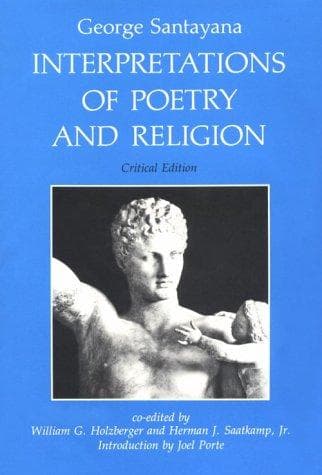
Interpretations of Poetry and ReligionSantayana, George
Religion
Interpretations of Poetry and Religion
Santayana, George
Aesthetics; Literature -- History and criticism; Poetry; Religion
An instinctive recognition of this necessity kept Greek mythology
ever ready to return to Nature to gather its materials afresh from a
docile, if poetical, observation of reality. The character of the god
must be studied in the manifestations of his chosen element; otherwise
men might forget that, although the form of the god was poetical, his
essence was a positive reality of the most practical kind. Zeus must
still toss his ambrosial locks with a certain irritation, in order
that we may recognize him in the rumblings of the sky; he must still
be capable of wrath and deliberate malice, that his awful hand may be
thought to have hurled the thunderbolt. Cronos must not be forbidden
to devour his children, else we should no longer reverence in him the
inexorable might of time. Mythology was quite right in not shrinking
from such poetic audacities. They were its chief title to legitimacy,
the proof, amid the embroideries of fancy which over-lay the divine
idea, that the god was not an invention, but a fact. He had been found,
he was known. His character, like all character, was merely a principle
which reflection discovered in his observed conduct. The reality, then,
of the mythological gods was initially unquestionable; and the more
faithful the study of Nature by which the poet was inspired, the more
authority did his prophetic vision retain.
But the intense imaginative vitality that must have preceded Homer and
Hesiod, the prodigious gift of sympathetic observation to which we owe
Zeus and Pan and all their endless retinue, was too glorious to last.
No later interpreter could find so much meaning in his text. Mythology
was accordingly placed in a sad dilemma, with either horn fatal to
its life; it must either be impoverished to remain sincere, or become
artificial to remain adequate. The history of Greek religion, on its
speculative side, is nothing but the story of this double decadence.
Reflection upon the process of Nature and desire for philosophic truth
led inevitably to a blank pantheism and to the reduction of positive
traditions to moral allegories. This was the direction taken by the
Stoic theology. On the other hand, adherence to the traditional gods,
with no further vivifying reference to their natural functions in
the world, could lead only to arbitrary fictions, which, having no
foothold or justification in reality, were incapable of withstanding
the first sceptical attack. What an age of imagination had intuited as
truth, an age of reflection could preserve only as fable; and as fable,
accordingly, the religion of the ancients survived throughout the
Christian ages. It remains still the mother-tongue of the imagination
and, in spite of all revolutions and admixtures, is the classic
language of art and poetry, which no other means of expression has
superseded.
Public-domain text, read in full here on John Shaqi.
Reviews
Reviews
No reviews yet
Be the first to share your thoughts on this work.
Join the Discussion
Join the discussion
Sign in to leave a comment or review.
Sign InorCreate an account