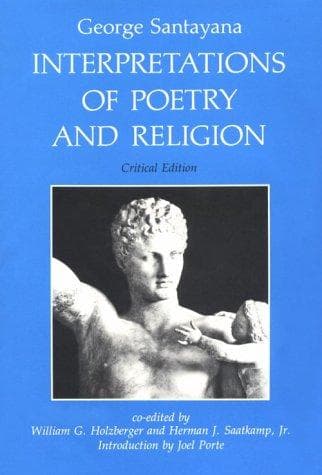
Interpretations of Poetry and Religion — John Shaqi
Interpretations of Poetry and ReligionSantayana, George
Religion
Interpretations of Poetry and Religion
Santayana, George
Aesthetics; Literature -- History and criticism; Poetry; Religion
The Greek philosophers, as a rule, proceeded cautiously in these
matters. They passed mythology by with a conventional reverence and
looked elsewhere for the true object of their personal religion. But
the old mythological impulse was not yet spent; it showed itself
still active in all the early philosophers who gave the godhead new
incarnations congruous with the character of their respective physical
systems. To the Socratic School the natural world was no longer the
sphere in which divinity was to be found. They looked for the divine
rather in moral and intelligible ideas. But not only did they carry the
mythological instinct with them into that new field, they also retained
it in the field of Nature, whenever they still regarded Nature as real.
Thus Aristotle, while he rejected the anthropomorphism of the popular
faith, attributing it to political exigencies, turned the forty-nine
spheres, of which he conjectured that the heaven might be composed,
into a pantheon of forty-nine divinities. Every primary movement,
he argued, must be the expression of an eternal essence by which
the movement is justified, as the movement of the mind in thinking
or loving is justified by the truth or excellence of the object of
thought or of love. Without such a worthy object, these spiritual
activities would be irrational; and no less irrational would be the
motion of the spheres, were each not obedient to the influence of some
sacred and immutable principle. Forty-nine gods accordingly exist;
but no more. For, since the essence of each is to be the governing
ideal of a motion, the number of motions in the sky determines the
number of divine first principles. The gods, we see, are still the
souls of Nature; a soul without a body would be a principle without an
application; there can be no gods, then, without a phenomenal function,
no gods that do not appear in the operations of Nature. This astronomic
mythology was surely not less poetical than that of Homer, even if, by
virtue of a certain cold and abstract purity, not unworthy of the stars
of which it spoke, it was more difficult and sublime. We may observe in
it a last application of the ancient mythological method by which the
phenomena of Nature became evidence of the existence and character of
the gods.
Public-domain text, read in full here on John Shaqi.
Reviews
Reviews
No reviews yet
Be the first to share your thoughts on this work.
Join the Discussion
Join the discussion
Sign in to leave a comment or review.
Sign InorCreate an account