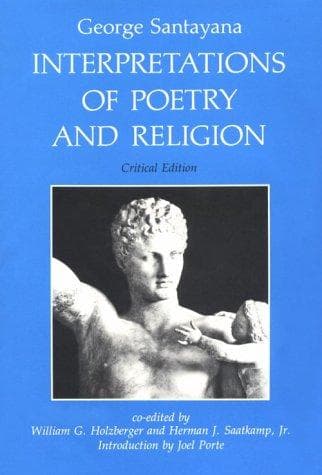
Interpretations of Poetry and Religion — John Shaqi
Interpretations of Poetry and ReligionSantayana, George
Religion
Interpretations of Poetry and Religion
Santayana, George
Aesthetics; Literature -- History and criticism; Poetry; Religion
But the celestial deities of Aristotle, and the minor creative gods of
Plato that correspond to them, retained too much poetic individuality
for the still poorer imagination of later times. The most religious
of sects during the classical decadence was that of the Stoics; in
them the spirit of conformity, which is a chief part even of the
religions of hope, constituted by its exclusive cultivation a religion
of despair. The name of Zeus, and an equally equivocal use of the word
"reason" to designate the regularity of Nature, served to disguise the
alien brutality of the power or law to which all the gods had been
reduced. Against the background of a materialistic pantheism, in which
Stoic speculation culminated, two positive interests stood out: one,
the resolute and truly human courage with which the Stoic faced the
reality as he conceived it, and kept his dignity and his conscience
pure although heaven might fall; the other, the efforts he made, in his
need for religion, to rejuvenate and reinterpret the pagan forms. The
fables he turned into ethical allegories, the oracles, auspices, and
other superstitious rites, he transformed into quasi-scientific ways of
reading the book of Nature and forecasting events.
This possibility of prophecy constituted the Stoic "providence" which
the sentimentality of modern apologists has been glad to confuse
with the _benevolent_ Providence of Christian dogma, a Providence
making for the salvation of men. The Stoic providence excluded that
essential element of benevolence; it was merely the fact that Nature
was prophetic of her own future, that her parts, both in space and in
time, were magically composed into one living system. Mythology thus
ended with the conception of a single god whose body was the whole
physical universe, whose fable was all history, and whose character
was the principle of the universal natural order. No attempt was made
by the ancient Stoics to make this divinity better or more amiable
than the evidence of experience showed it to be; the self-centred,
self-sufficient Stoic morality, the recourse to suicide, and the
equality in happiness and dignity between the wise man and Zeus, all
prove quite conclusively that nothing more was asked or expected of
Nature than what she chose to give; to be virtuous was in man's power,
and nothing else was a good to man. The universe could neither benefit
nor injure him; and thus we see that, despite a reverential tone and
an occasional reminiscence of the thunderbolts of Zeus, the Stoic's
conscience knew how to scorn the moral nothingness of that blank deity
to which his metaphysics had reduced the genial company of the gods.
Public-domain text, read in full here on John Shaqi.
Reviews
Reviews
No reviews yet
Be the first to share your thoughts on this work.
Join the Discussion
Join the discussion
Sign in to leave a comment or review.
Sign InorCreate an account