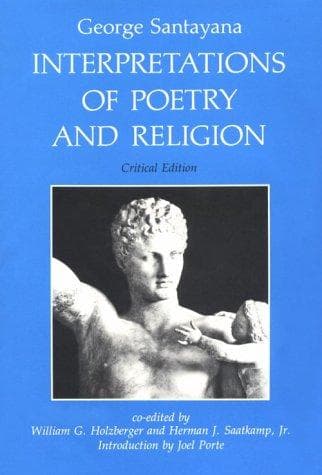
Interpretations of Poetry and ReligionSantayana, George
Religion
Interpretations of Poetry and Religion
Santayana, George
Aesthetics; Literature -- History and criticism; Poetry; Religion
Thus the reality which the naturalistic gods had borrowed from the
elements proved to be a dangerous prerogative; being real and manifest,
these gods had to be conceived according to our experience of their
operation, so that with every advance in scientific observation
theology had to be revised, and something had to be subtracted from
the personality and benevolence of the gods. The moral character
originally attributed to them necessarily receded before the clearer
definition of natural forces and the accumulated experience of
national disasters. Finally, little remained of the gods except their
names, reduced to rhetorical synonyms for the various departments of
Nature; Phoebus was nothing but a bombastic way of saying the sun;
Hephæstus became nothing but fire, Eros or Aphrodite nothing but love,
Zeus nothing but the general force and law of Nature. Thus the gods
remained real, but were no longer gods. If belief in their reality
was to be kept up, they could not retain too many attributes that
had no empirical manifestation. They must be reduced, as it were, to
their fighting weight. All that the imagination had added to them by
way of personal character, sanctity, and life must be rejected as
anthropomorphism and fable.
Such is the necessary logic of natural religion. If Nature manifests
the existence of a god, she must to that extent manifest his character;
if she does not manifest his character, she cannot involve his
existence. We observe to-day a process exactly analogous to that by
which the natural divinities of Greece were reduced again to the
physical or social forces from which poetry had originally evoked
their forms. Many minds are grown too timid to build their religious
faith unblushingly on revelation, or on that moral imagination or
inward demand which revelation comes to express and to satisfy. They
seek, therefore, to naturalize the Deity and to identify it with some
principle of history, of Nature, or of logic. But this identification
cannot be made without great concessions on both sides. The
accommodations which ensue inevitably involve many equivocations, and
some misrepresentations of the heterogeneous principles, now natural,
now moral, which it is sought to unify. Confused and agonized by
these contradictions, the natural theologian, if he keep his honesty,
can only rest in the end in a chastened recognition of the facts of
experience, toward which he will, no doubt, exercise his acquired
habits of acquiescence and euphemism. But these habits, the survival
of which gives his philosophy some air of being still a religion, will
not be inherited by his disciples and successors; a pious manner may
survive religious faith, but will not survive it long. The society
to whom the reformer teaches a reticent and embarrassed naturalism
will discard the reticence and avow the naturalism with pride. The
masses of men will see no reason why they should not live out their
Public-domain text, read in full here on John Shaqi.
Reviews
Reviews
No reviews yet
Be the first to share your thoughts on this work.
Join the Discussion
Join the discussion
Sign in to leave a comment or review.
Sign InorCreate an account