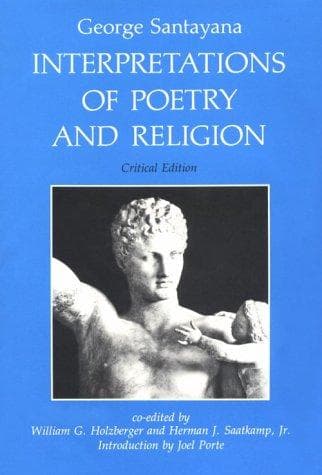
Interpretations of Poetry and ReligionSantayana, George
Religion
Interpretations of Poetry and Religion
Santayana, George
Aesthetics; Literature -- History and criticism; Poetry; Religion
Had this remarkable doctrine been carried out fully it would have led
to important results. We should have had goodness as the criterion of
divinity, to the exclusion of power. God would have become avowedly an
ideal, a pattern to which the world might or might not conform. Such
potential conformity would have remained dependent on causes, natural
or free, with which God, not being a power, could have nothing to do.
Plato and Aristotle did, in fact, construct a theology on these lines,
but they obscured its purity in their well-meant attempts to connect
(more or less mythically or magically) their own Socratic principle
of excellence with the cosmic principles of the earlier philosophers.
The elements of confusion and pantheism which were thus introduced
into the Socratic philosophy made it more acceptable, perhaps, to the
theologians of later times, in whose religion a pantheistic tendency
was also latent. In the hands of Jewish, Christian, or Mohammedan
commentators the mythical and magical part of the Greek conceptions
was naturally emphasized and the rational part reinterpreted and
obscured. Plato had spoken, in one of his myths, of a Demiurgos, a
personification of the Idea of the Good, who directly or indirectly
made the world in his own image, rendering it as perfect as the
indeterminate Chaos he worked on would allow. Aristotle had spoken of
an intelligence, happy and self-contemplative, who was the principle of
movement in the heavens, and through the heavens in the rest of Nature.
Such expressions had a sound far too congruous with Mosaic doctrine not
to be seized upon with joy by the apologists of the new faiths, who
were glad to invoke the authority of classic poets and philosophers in
favour of doctrines that in their Hebrew expression might so easily
seem crude and irrational to the Gentiles. This assimilation gave to
the casual myths of Plato and to the meagre though bold argumentation
of Aristotle a turn and a significance which they hardly had to their
authors. If we approach these philosophers as we should from the point
of view of Greek literature and life, and prepare ourselves to see
in them the disciples of Socrates rather than (what Plato was once
actually declared to be) the disciples of Moses, we shall see that
they were simply, mythologists of the Ideal; they refined the gods of
tradition into patrons of civic discipline and art, the gods of natural
philosophy into principles of intelligibility and beauty.
Public-domain text, read in full here on John Shaqi.
Reviews
Reviews
No reviews yet
Be the first to share your thoughts on this work.
Join the Discussion
Join the discussion
Sign in to leave a comment or review.
Sign InorCreate an account