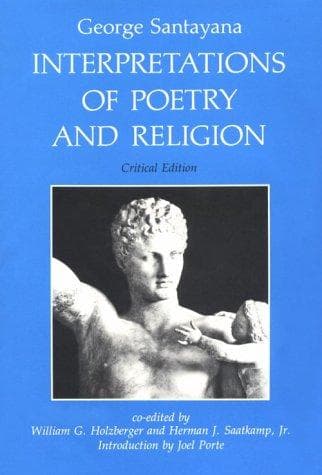
Interpretations of Poetry and ReligionSantayana, George
Religion
Interpretations of Poetry and Religion
Santayana, George
Aesthetics; Literature -- History and criticism; Poetry; Religion
The creation described in the Timæus is a transparent parable. Elements
which ethical reflection distinguishes in the field of experience
are turned in that dialogue, with undisguised freedom of fancy, into
so many half-personified primitive powers; the Ideas, the Demiurgos,
Chaos, the Indeterminate, and the "gods of gods." Plato has not
forgotten the lessons of Socrates and Parmenides. He distrusts as much
as they any natural or genetic philosophy of existence. He virtually
tells us that, if we must have a history of creation, we can hardly
do better than to take ideal or moral principles, combine them as we
might so many material elements, and see how the intelligible part
of existence may thus receive a quasi-explanation. God remains the
creator of the good only, because what he is mythically said to create
is merely that in Nature which spontaneously resembles him or conforms
to his idea; only this element in Nature is intelligible or good, and
therefore the principle of goodness may be said to be its cause. Thus,
for example, if we chose to write an Anatomy of Melancholy, we might
attribute to the Demon of Spleen or to the Blue Devils only the sombre
elements of that soulful compound, which, however, the evil imps would
eternally tend to make as absolutely dyspeptic and like unto themselves
as its primordial texture would allow. In exactly such a way Plato,
in his allegorical manner, constructed a universe with a poetical
machinery of moral forces, personified and treated as agents. When
the thin veil of allegory is drawn aside, there remains nothing but a
splendid illustration of the Socratic philosophy; we are taught that
the only science is moral science, and that, if we wish to understand
the world, we must bend our minds to the definition of its qualities
and values, which are all that is intelligible in it. Essences and
values alone are knowable and fixed and amenable to science. If we
insist on history and cosmogony, we must be satisfied with having them
presented to us in allegorical form, and made to follow ethics as the
Timæus follows the Republic. Natural philosophy can be nothing but a
sort of analytic retrospect by which we trace the first glimmerings
and the progressive manifestation in Nature of those ideas which have
authority over our own minds.
Public-domain text, read in full here on John Shaqi.
Reviews
Reviews
No reviews yet
Be the first to share your thoughts on this work.
Join the Discussion
Join the discussion
Sign in to leave a comment or review.
Sign InorCreate an account