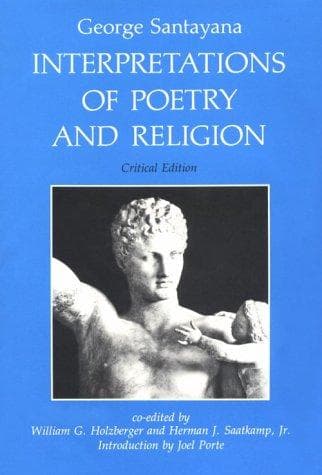
Interpretations of Poetry and Religion — John Shaqi
Interpretations of Poetry and ReligionSantayana, George
Religion
Interpretations of Poetry and Religion
Santayana, George
Aesthetics; Literature -- History and criticism; Poetry; Religion
Phenomena had for Plato existence without reality, that is, without
intelligibility or value. They were a mere appearance. We need not be
surprised, then, that he refused altogether to construct a theology
by the poetic interpretation of phenomena and preferred to construct
one allegorically out of his moral conceptions, the good and the
ideal. Aristotle, too, while adhering incidentally, as we have seen,
to a purified astronomical theology, capped this with a purified moral
theology of his own. The Platonic picture-gallery of ideas, with
the abstract principle of excellence that unified them, gave place
in his philosophy to an Ideal realized in the concrete and existing
as an individual. We may venture to say that among the thinkers of
all nations Aristotle was the first to reach the conception of what
may fitly be called God. Neither the national deity of the Hebrews,
as then conceived, nor the natural deities of the Gentiles, nor
the half-physical, half-logical abstractions of the earlier Greek
philosophers really corresponded to the notion of a being spiritual,
personal, and perfect, immutable without being abstract, and omnipotent
without effort and without degradation. Aristotle first constructed
this ideal, not out of his fancy, but by building on the solid ground
of human nature and following to their point of union the lines
which moral aspiration and effort actually follow. Nay, the ideal he
pointed to was to be the goal not of human life only but of natural
life in all its forms. The analytic study of Nature (a study which at
the same time must be imaginative and sympathetic) could guide us to
the conception of her inner needs and tendencies and of what their
proper fulfilment would be. We could then see that this fulfilment
would lie in intelligence and thought. Growth is for the sake of the
fruition of life, and the fruition of life consists in the pursuit and
attainment of objects. The moral virtues belong to the pursuit, the
intellectual to the attainment. Knowledge is the end of all endeavour,
the justification and fulfilment of all growth. Intelligence is the
clarification of love.
Public-domain text, read in full here on John Shaqi.
Reviews
Reviews
No reviews yet
Be the first to share your thoughts on this work.
Join the Discussion
Join the discussion
Sign in to leave a comment or review.
Sign InorCreate an account