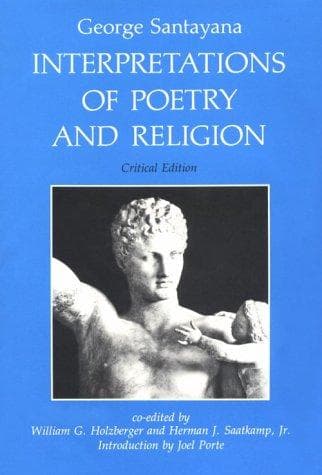
Interpretations of Poetry and ReligionSantayana, George
Religion
Interpretations of Poetry and Religion
Santayana, George
Aesthetics; Literature -- History and criticism; Poetry; Religion
The crucifixion, for example, would remain a tragic incident without
further significance, if we regard it merely as a historical fact; to
make it a religious mystery, an idea capable of converting the world,
the moral imagination must transform it into something that happens for
the sake of the soul, so that each believer may say to himself that
Christ so suffered for the love of him. And such a thought is surely
the objectification of an inner impulse; the idea of Christ becomes
something spiritual, something poetical. What literal meaning could
there be in saying that one man or one God died for the sake of each
and every other individual? By what effective causal principle could
their salvation be thought to necessitate his death, or his death to
make possible their salvation? By an [Greek: usteron proteron] natural
to the imagination; for in truth the matter is reversed. Christ's death
is a symbol of human life. Men could "believe in" his death, because
it was a figure and premonition of the burden of their experience.
That is why, when some Apostle told them the story, they could say to
him: "Sir, I perceive that thou art a prophet: thou hast told me all
things whatsoever I have felt." Thus the central fact of all Christ's
history, narrated by every Evangelist, could still be nothing but a
painful incident, as unessential to the Christian religion as the death
of Socrates to the Socratic philosophy, were it not transformed by
the imagination of the believer into the counterpart of his own moral
need. Then, by ceasing to be viewed as a historical fact, the death of
Christ becomes a religious inspiration. The whole of Christian doctrine
is thus religious and efficacious only when it becomes poetry, because
only then is it the felt counterpart of personal experience and a
genuine expansion of human life.
Public-domain text, read in full here on John Shaqi.
Reviews
Reviews
No reviews yet
Be the first to share your thoughts on this work.
Elsewhere in the archive
Join the Discussion
Join the discussion
Sign in to leave a comment or review.
Sign InorCreate an account