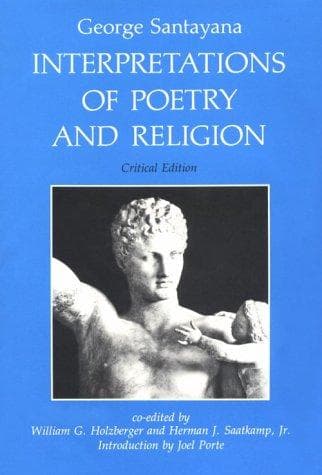
Interpretations of Poetry and ReligionSantayana, George
Religion
Interpretations of Poetry and Religion
Santayana, George
Aesthetics; Literature -- History and criticism; Poetry; Religion
Take, as another example, the doctrine of eternal rewards and
punishments. Many perplexed Christians of our day try to reconcile
this spirited fable with their modern horror of physical suffering and
their detestation of cruelty; and it must be admitted that the image
of men suffering unending tortures in retribution for a few ignorant
and sufficiently wretched sins is, even as poetry, somewhat repellent.
The idea of torments and vengeance is happily becoming alien to our
society and is therefore not a natural vehicle for our religion. Some
accordingly reject altogether the Christian doctrine on this point,
which is too strong for their nerves. Their objection, of course, is
not simply that there is no evidence of its truth. If they asked for
evidence, would they believe anything? Proofs are the last thing
looked for by a truly religious mind which feels the imaginative
fitness of its faith and knows instinctively that, in such a matter,
imaginative fitness is all that can be required. The reason men reject
the doctrine of eternal punishment is that they find it distasteful
or unmeaning. They show, by the nature of their objections, that they
acknowledge poetic propriety or moral truth to be the sole criterion of
religious credibility.
But, passing over the change of sentiment which gives rise to
this change of doctrine, let us inquire of what reality Christian
eschatology was the imaginative rendering. What was it in the actual
life of men that made them think of themselves as hanging between
eternal bliss and eternal perdition? Was it not the diversity, the
momentousness, and the finality of their experience here? No doubt
the desire to make the reversal of the injustices of this world as
melodramatic and picturesque as possible contributed to the adoption
of this idea; the ideal values of life were thus contrasted with its
apparent values in the most absolute and graphic manner. But we may
say that beneath this motive, based on the exigences of exposition
and edification, there was a deeper intuition. There was the genuine
moralist's sympathy with a philosophic and logical view of immortality
rather than with a superstitious and sentimental one. Another life
exists and is infinitely more important than this life; but it is
reached by the intuition of ideals, not by the multiplication of
phenomena; it is an eternal state not an indefinite succession of
changes. Transitory life ends for the Christian when the balance-sheet
of his individual merits and demerits is made up, and the eternity that
ensues is the eternal reality of those values.
Public-domain text, read in full here on John Shaqi.
Reviews
Reviews
No reviews yet
Be the first to share your thoughts on this work.
Elsewhere in the archive
Join the Discussion
Join the discussion
Sign in to leave a comment or review.
Sign InorCreate an account