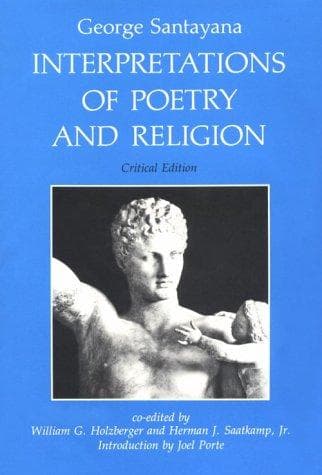
Interpretations of Poetry and Religion — John Shaqi
Interpretations of Poetry and ReligionSantayana, George
Religion
Interpretations of Poetry and Religion
Santayana, George
Aesthetics; Literature -- History and criticism; Poetry; Religion
together among themselves, we add the cross lights of our prejudices
and the impossibility of fitting reality into the frame we have made
for it in our ignorance of its constitution and extent. And as we love
our hopes, and detest the experience that seems to contradict them,
we add fanaticism to our confusion. The habits of the imagination, in
conflict with the facts of sense, thus come to cloud science with
passion, with fiction, with sentimental prejudice. Nor is this the
end of our troubles. For Imagination herself suffers violence in this
struggle; she seeks to reduce herself to conformity with existence,
in the hope of vindicating her nominal authority at the price of some
concessions. She begins to feign that she demanded nothing but what
she finds. Thus she loses her honesty and freedom, becomes a flatterer
of things instead of the principle of their ideal correction, and in
the attempt to prove herself prophetic and literally valid (as in a
moment of infatuation she had fancied herself to be) she forfeits that
symbolic truth, that inner propriety, which gave her a moral value.
Thus the false steps of the imagination lead to a contorted science and
to a servile ideal.
These complications not unnaturally inspire discouragement and a sense
of the hopeless relativity of human thought. Indeed, if there be any
special endowment of mind and body called human nature, as there seems
to be, it is obvious that all human experience must be relative to
that. But the truth, the absolute reality, surrounds and precedes
these operations of finite faculty. What value, then, we may say, have
these various ideals or perceptions, or the conflicts between them?
Are not our senses as human, as "subjective" as our wills? Is not the
understanding as visionary as the fancy? Does it not transform the
Unknowable into as remote a symbol as does the vainest dream?
The answer which a rational philosophy would make to these questions
would be a double one. It is true that every idea is equally relative
to human nature and that nothing can be represented in the human mind
except by the operation of human faculties. But it is not true that all
these products of human ideation are of equal value, since they are not
equally conducive to human purposes or satisfactory to human demands.
Public-domain text, read in full here on John Shaqi.
Reviews
Reviews
No reviews yet
Be the first to share your thoughts on this work.
Join the Discussion
Join the discussion
Sign in to leave a comment or review.
Sign InorCreate an account