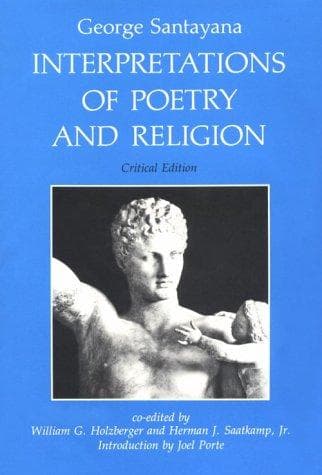
Interpretations of Poetry and ReligionSantayana, George
Religion
Interpretations of Poetry and Religion
Santayana, George
Aesthetics; Literature -- History and criticism; Poetry; Religion
The imagination, even when its premonitions are not wholly justified
by subsequent experience, has thus a noble role to play in the life
of man. Without it his thoughts would be not only far too narrow
to represent, although it were symbolically, the greatness of the
universe, but far too narrow even to render the scope of his own
life and the conditions of his practical welfare. Without poetry and
religion the history of mankind would have been darker than it is. Not
only would emotional life have been poorer, but the public conscience,
the national and family spirit, so useful for moral organization and
discipline, would hardly have become articulate. By what a complex
and uninspired argumentation would the pure moralist have to insist
upon those duties which the imagination enforces so powerfully in
oaths sworn before the gods, in commandments written by the finger of
God upon stone tablets, in visions of hell and heaven, in chivalrous
love and loyalty, and in the sense of family dignity and honour? What
intricate, what unavailing appeals to positive interests would have to
be made before those quick reactions could be secured in large bodies
of people which can be produced by the sight of a flag or the sound
of a name? The imagination is the great unifier of humanity. Men's
perceptions may be various, their powers of understanding very unequal;
but the imagination is, as it were, the self-consciousness of instinct,
the contribution which the inner capacity and demand of the mind makes
to experience. To indulge the imagination is to express the universal
self, the common and contagious element in all individuals, that
rudimentary potency which they all share. To stimulate the imagination
is to produce the deepest, the most pertinacious emotions. To repress
it is to chill the soul, so that even the clearest perception of the
truth remains without the joy and impetuosity of conviction. The
part played by imagination is thus indispensable; but obviously the
necessity and beneficence of this contribution makes the dangers
of it correspondingly great. Wielding a great power, exercising an
omnipresent function, the imagination may abuse a great force. While
its inspirations coincide with what would be the dictates of reason,
were reason audible in the world, all is well, and the progress of man
is accelerated by his visions; but being a principle _a priori_ the
imagination is an irresponsible principle; its rightness is an inward
rightness, and everything in the real world may turn out to be disposed
otherwise than as it would wish. Our imaginative preconceptions
are then obstacles to the perception of fact and of rational duty;
the faith that stimulated our efforts and increased our momentum,
multiplies our wanderings. The too hasty organization of our thoughts
becomes the cause of their more prolonged disorganization, for to the
natural obscurity of things and the difficulty of making them fit
Public-domain text, read in full here on John Shaqi.
Reviews
Reviews
No reviews yet
Be the first to share your thoughts on this work.
Join the Discussion
Join the discussion
Sign in to leave a comment or review.
Sign InorCreate an account