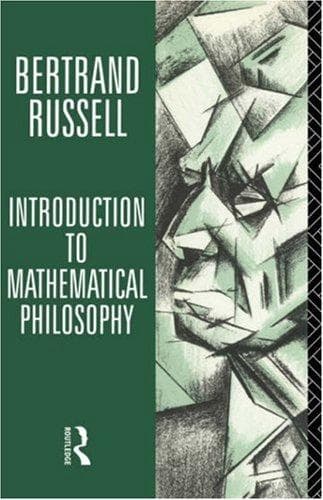
Introduction to Mathematical PhilosophyRussell, Bertrand
Philosophy
Introduction to Mathematical Philosophy
Russell, Bertrand
Mathematics -- Philosophy
THE question "What is a number?" is one which has been
often asked, but has only been correctly answered in our own
time. The answer was given by Frege in 1884, in his Grundlagen
der Arithmetik.[3]
Although this book is quite short, not difficult,
and of the very highest importance, it attracted almost no
attention, and the definition of number which it contains remained
practically unknown until it was rediscovered by the
present author in 1901.
[3]The same answer is given more fully and with more development in
his Grundgesetze der Arithmetik, vol. I., 1893.
In seeking a definition of number, the first thing to be clear
about is what we may call the grammar of our inquiry. Many
philosophers, when attempting to define number, are really
setting to work to define plurality, which is quite a different
thing. Number is what is characteristic of numbers, as man
is what is characteristic of men. A plurality is not an instance
of number, but of some particular number. A trio of men,
for example, is an instance of the number 3, and the number 3
is an instance of number; but the trio is not an instance of
number. This point may seem elementary and scarcely worth
mentioning; yet it has proved too subtle for the philosophers,
with few exceptions.
A particular number is not identical with any collection of
terms having that number: the number 3 is not identical with
[Pg 11]
the trio consisting of Brown, Jones, and Robinson. The number 3
is something which all trios have in common, and which distinguishes
them from other collections. A number is something
that characterises certain collections, namely, those that have
that number.
Instead of speaking of a "collection," we shall as a rule speak
of a "class," or sometimes a "set." Other words used in
mathematics for the same thing are "aggregate" and "manifold."
We shall have much to say later on about classes. For
the present, we will say as little as possible. But there are
some remarks that must be made immediately.
A class or collection may be defined in two ways that at first
sight seem quite distinct. We may enumerate its members, as
when we say, "The collection I mean is Brown, Jones, and
Robinson." Or we may mention a defining property, as when
we speak of "mankind" or "the inhabitants of London." The
definition which enumerates is called a definition by "extension,"
and the one which mentions a defining property is called
a definition by "intension." Of these two kinds of definition,
the one by intension is logically more fundamental. This is
shown by two considerations: (1) that the extensional definition
can always be reduced to an intensional one; (2) that the
intensional one often cannot even theoretically be reduced to
the extensional one. Each of these points needs a word of
explanation.
Public-domain text, read in full here on John Shaqi.
Reviews
Reviews
No reviews yet
Be the first to share your thoughts on this work.
Join the Discussion
Join the discussion
Sign in to leave a comment or review.
Sign InorCreate an account