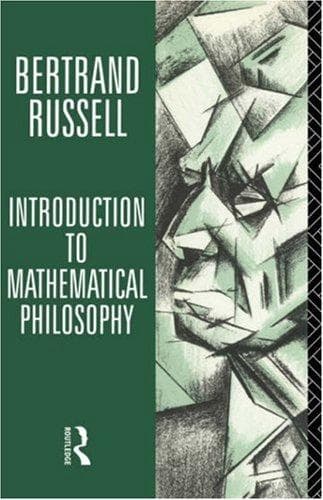
Introduction to Mathematical Philosophy — John Shaqi
Introduction to Mathematical PhilosophyRussell, Bertrand
Philosophy
Introduction to Mathematical Philosophy
Russell, Bertrand
Mathematics -- Philosophy
(1) Brown, Jones, and Robinson all of them possess a certain
property which is possessed by nothing else in the whole universe,
namely, the property of being either Brown or Jones or Robinson.
This property can be used to give a definition by intension of
the class consisting of Brown and Jones and Robinson. Consider
such a formula as " is Brown or is Jones or is Robinson."
This formula will be true for just three 's, namely, Brown and
Jones and Robinson. In this respect it resembles a cubic equation
with its three roots. It may be taken as assigning a property
common to the members of the class consisting of these three
[Pg 12]
men, and peculiar to them. A similar treatment can obviously
be applied to any other class given in extension.
(2) It is obvious that in practice we can often know a great
deal about a class without being able to enumerate its members.
No one man could actually enumerate all men, or even all the
inhabitants of London, yet a great deal is known about each of
these classes. This is enough to show that definition by extension
is not necessary to knowledge about a class. But when we come
to consider infinite classes, we find that enumeration is not even
theoretically possible for beings who only live for a finite time.
We cannot enumerate all the natural numbers: they are 0, 1, 2,
3, and so on. At some point we must content ourselves with
"and so on." We cannot enumerate all fractions or all irrational
numbers, or all of any other infinite collection. Thus our knowledge
in regard to all such collections can only be derived from a
definition by intension.
These remarks are relevant, when we are seeking the definition
of number, in three different ways. In the first place, numbers
themselves form an infinite collection, and cannot therefore
be defined by enumeration. In the second place, the collections
having a given number of terms themselves presumably form an
infinite collection: it is to be presumed, for example, that there
are an infinite collection of trios in the world, for if this were
not the case the total number of things in the world would be
finite, which, though possible, seems unlikely. In the third
place, we wish to define "number" in such a way that infinite
numbers may be possible; thus we must be able to speak of
the number of terms in an infinite collection, and such a collection
must be defined by intension, i.e. by a property common to all
its members and peculiar to them.
Public-domain text, read in full here on John Shaqi.
Reviews
Reviews
No reviews yet
Be the first to share your thoughts on this work.
Join the Discussion
Join the discussion
Sign in to leave a comment or review.
Sign InorCreate an account