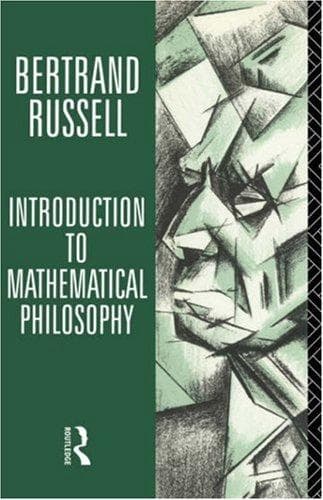
Introduction to Mathematical PhilosophyRussell, Bertrand
Philosophy
Introduction to Mathematical Philosophy
Russell, Bertrand
Mathematics -- Philosophy
If this is true, it follows, of course, that there are many classes
of individuals having terms, and that the total number of
individuals in the world is not an inductive number. For, by
the axiom, there is at least one class having terms, from which
it follows that there are many classes of terms and that is
not the number of individuals in the world. Since is any
inductive number, it follows that the number of individuals
in the world must (if our axiom be true) exceed any inductive
number. In view of what we found in the preceding chapter,
about the possibility of cardinals which are neither inductive
nor reflexive, we cannot infer from our axiom that there are at
least individuals, unless we assume the multiplicative axiom.
But we do know that there are at least classes of classes,
since the inductive cardinals are classes of classes, and form a
progression if our axiom is true. The way in which the need
for this axiom arises may be explained as follows:—One of
Peano's assumptions is that no two inductive cardinals have the
same successor, i.e. that we shall not have unless
, if and are inductive cardinals. In Chapter VIII. we
had occasion to use what is virtually the same as the above
assumption of Peano's, namely, that, if is an inductive cardinal,
[Pg 131]
is not equal to . It might be thought that this could be
proved. We can prove that, if is an inductive class, and is
the number of members of , then is not equal to .
This proposition is easily proved by induction, and might be
thought to imply the other. But in fact it does not, since there
might be no such class as . What it does imply is this: If
is an inductive cardinal such that there is at least one class
having members, then is not equal to . The axiom of
infinity assures us (whether truly or falsely) that there are classes
having members, and thus enables us to assert that is not
equal to . But without this axiom we should be left with
the possibility that and might both be the null-class.
Public-domain text, read in full here on John Shaqi.
Reviews
Reviews
No reviews yet
Be the first to share your thoughts on this work.
Elsewhere in the archive
Join the Discussion
Join the discussion
Sign in to leave a comment or review.
Sign InorCreate an account