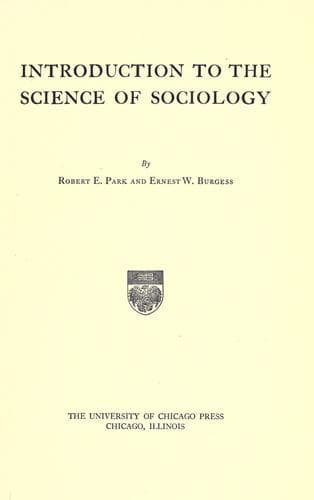
Introduction to the Science of SociologyPark, Robert Ezra
General
Introduction to the Science of Sociology
Park, Robert Ezra
Sociology
The life of a man is a double series--a series of effects produced in
him by the rest of the world, and a series of effects produced in that
world by him. A man's make-up or nature equals his tendencies to be
influenced in certain ways by the world and to react in certain ways to
it.
If we could thus adequately describe each of a million human beings--if,
for each one, we could prophesy just what the response would be to every
possible situation of life--the million men would be found to differ
widely. Probably no two out of the million would be so alike in mental
nature as to be indistinguishable by one who knew their entire natures.
Each has an individuality which marks him off from other men. We may
study a human being in respect to his common humanity, or in respect to
his individuality. In other words, we may study the features of
intellect and character which are common to all men, to man as a
species; or we may study the differences in intellect and character
which distinguish individual men.
Individuals are commonly considered as differing in respect to such
traits either quantitatively or qualitatively, either in degree or in
kind. A quantitative difference exists when the individuals have
different amounts of the same trait. Thus, "John is more attentive to
his teacher than James is"; "Mary loves dolls less than Lucy does"; "A
had greater devotion to his country than B had"; are reports of
quantitative differences, of differences in the amount of what is
assumed to be the same kind of thing. A qualitative difference exists
when some quality or trait possessed by one individual is lacking in the
other. Thus, "Tom knows German, Dick does not"; "A is artistic, B is
scientific"; "C is a man of thought, D is a man of action"; are reports
of the fact that Tom has some positive amount or degree of the trait
"knowledge of German" while Dick has none of it; that A has some
positive amount of ability and interest in art while B has zero; whereas
B has a positive amount of ability in science, of which A has none; and
so on.
A qualitative difference in intellect or character is thus really a
quantitative difference wherein one term is zero, or a compound of two
or more quantitative differences. All intelligible differences are
ultimately quantitative. The difference between any two individuals, if
describable at all, is described by comparing the amounts which A
possesses of various traits with the amounts which B possesses of the
same traits. In intellect and character, differences of kind between one
individual and another turn out to be definable, if defined at all, as
compound differences of degree.
Public-domain text, read in full here on John Shaqi.
Reviews
Reviews
No reviews yet
Be the first to share your thoughts on this work.
Elsewhere in the archive
Join the Discussion
Join the discussion
Sign in to leave a comment or review.
Sign InorCreate an account