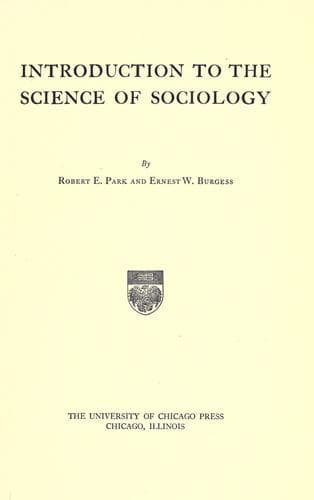
Introduction to the Science of SociologyPark, Robert Ezra
General
Introduction to the Science of Sociology
Park, Robert Ezra
Sociology
We must remember that the European peasant grows up in a (more or less)
civilized environment; he learns a (more or less) well-developed and
written language, which serves as an easier instrument and a stronger
inducement for abstract thought; he is born into a (more or less)
advanced religion. All these advantages and the advantage of a more
complex education the European peasant owes to his superiors in ability
and civilization. Rob the peasant of these opportunities, plunge him
into the social environment of present primitive man, and what
difference in thinking power will be left between them?
The answer to this question brings me to the second point of difference
which I have mentioned--the difference in variability. I have already
alluded to the divergencies in temperament to be found among the members
of every primitive community. But well marked as are these and other
individual differences, I suspect that they are less prominent among
primitive than among more advanced peoples. This difference in
variability, if really existent, is probably the outcome of more
frequent racial admixture and more complex social environment in
civilized communities. In another sense, the variability of the savage
is indicated by the comparative data afforded by certain psychological
investigations. A civilized community may not differ much from a
primitive one in the mean or average of a given character, but the
extreme deviations which it shows from that mean will be more numerous
and more pronounced. This kind of variability has probably another
source. The members of a primitive community behave toward the applied
test in the simplest manner, by the use of a mental process which we
will call A, whereas those of a more advanced civilization employ other
mental processes, in addition to A, say B, C, D, or E, each individual
using them in different degrees for the performance of one and the same
test. Finally, there is in all likelihood a third kind of variability,
whose origin is ultimately environmental, which is manifested by
extremes of nervous instability. Probably the exceptionally defective
and the exceptional genius are more common among civilized than among
primitive peoples.
Similar features undoubtedly meet us in the study of sexual differences.
The average results of various tests of mental ability applied to men
and women are not, on the whole, very different for the two sexes, but
the men always show considerably greater individual variation than the
women. And here, at all events, the relation between the frequency of
mental deficiency and genius in the two sexes is unquestionable. Our
asylums contain a considerably greater number of males than of females,
as a compensation for which genius is decidedly less frequent in females
than in males.
7. Individual Differences[64]
Public-domain text, read in full here on John Shaqi.
Reviews
Reviews
No reviews yet
Be the first to share your thoughts on this work.
Elsewhere in the archive
Join the Discussion
Join the discussion
Sign in to leave a comment or review.
Sign InorCreate an account