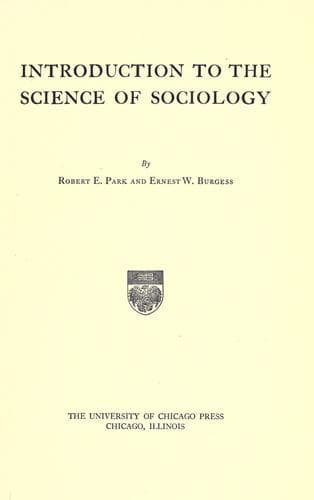
Introduction to the Science of SociologyPark, Robert Ezra
General
Introduction to the Science of Sociology
Park, Robert Ezra
Sociology
The original nature of man is roughly what is common to all men
minus all adaptations to tools, houses, clothes, furniture,
words, beliefs, religions, laws, science, the arts, and to
whatever in other men's behavior is due to adaptations to them.
From human nature as we find it, take away, first, all that is
in the European but not in the Chinaman, all that is in the
Fiji Islander but not in the Esquimaux, all that is local or
temporary. Then take away also the effects of all products of
human art. What is left of human intellect and character is
largely original--not wholly, for all those elements of
knowledge which we call ideas and judgments must be subtracted
from his responses. Man originally possesses only capacities
which, after a given amount of education, will produce ideas
and judgments.
Such, in general, is the nature of human beings before that nature has
been modified by experience and formed by the education and the
discipline of contact and intercourse with their fellows.
Several writers, among them William James, have attempted to make a
rough inventory of the special instinctive tendencies with which human
beings are equipped at birth. First of all there are the simpler
reflexes such as "crying, sneezing, snoring, coughing, sighing,
sobbing, gagging, vomiting, hiccuping, starting, moving the limb in
response to its being tickled, touched or blown upon, spreading the toes
in response to its being touched, tickled, or stroked on the sole of the
foot, extending and raising the arms at any sudden sensory stimulus, or
the quick pulsation of the eyelid."
Then there are the more complex original tendencies such as sucking,
chewing, sitting up, and gurgling. Among the more general unlearned
responses of children are fear, anger, pugnacity, envy, jealousy,
curiosity, constructiveness, love of festivities, ceremonies and
ordeals, sociability and shyness, secretiveness, etc. Thorndike, who
quotes this list at length, has sought to give definiteness to its
descriptions by clearly defining and distinguishing the character of the
situation to which the behavior cited is a response. For example, to the
situation, "strange man or animal, to solitude, black things, dark
places, holes and corners, a human corpse," the native and unlearned
response is fear. The original response of man to being alone is an
experience of discomfort, to perceiving a crowd, "a tendency to join
them and do what they are doing and an unwillingness to leave off and go
home." It is part of man's original nature when he is in love to conceal
his love affairs, and so forth.
It is evident from this list that what is meant by original nature is
not confined to the behavior which manifests itself at birth, but
includes man's spontaneous and unlearned responses to situations as they
arise in the experience of the individual.
Public-domain text, read in full here on John Shaqi.
Reviews
Reviews
No reviews yet
Be the first to share your thoughts on this work.
Elsewhere in the archive
Join the Discussion
Join the discussion
Sign in to leave a comment or review.
Sign InorCreate an account