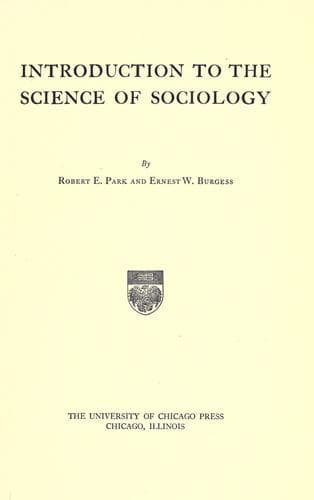
Introduction to the Science of SociologyPark, Robert Ezra
General
Introduction to the Science of Sociology
Park, Robert Ezra
Sociology
The widespread interest in the study of children has inspired in recent
years a considerable literature bearing upon the original and inherited
tendencies of human nature. The difficulty of distinguishing between
what is original and what is acquired among the forms of behavior
reported upon, and the further difficulty of obtaining accurate
descriptions of the situations to which the behavior described was a
response, has made much of this literature of doubtful value for
scientific purposes. These studies have, nevertheless, contributed to a
radical change in our conceptions of human nature. They have shown that
the distinction between the mind of man and that of the lower animals is
not so wide nor so profound as was once supposed. They have emphasized
the fact that human nature rests on animal nature, and the transition
from one to the other, in spite of the contrast in their separate
achievements, has been made by imperceptible gradations. In the same
way they have revealed, beneath differences in culture and individual
achievement, the outlines of a pervasive and relatively unchanging human
nature in which all races and individuals have a common share.
The study of human nature begins with description, but it goes on from
that point to explanation. If the descriptions which we have thus far
had of human nature are imperfect and lacking in precision, it is
equally true that the explanations thus far invented have, on the whole,
been inadequate. One reason for this has been the difficulty of the
task. The mechanisms which control human behavior are, as might be
expected, tremendously complicated, and the problem of analyzing them
into their elementary forms and reducing their varied manifestations to
precise and lucid formulas is both intricate and perplexing.
The foundation for the explanation of human nature has been laid,
however, by the studies of behavior in animals and the comparative study
of the physiology of the nervous system. Progress has been made, on the
one hand, by seeking for the precise psycho-chemical process involved in
the nervous reactions, and on the other, by reducing all higher mental
processes to elementary forms represented by the tropisms and reflex
actions.
Public-domain text, read in full here on John Shaqi.
Reviews
Reviews
No reviews yet
Be the first to share your thoughts on this work.
Elsewhere in the archive
Join the Discussion
Join the discussion
Sign in to leave a comment or review.
Sign InorCreate an account