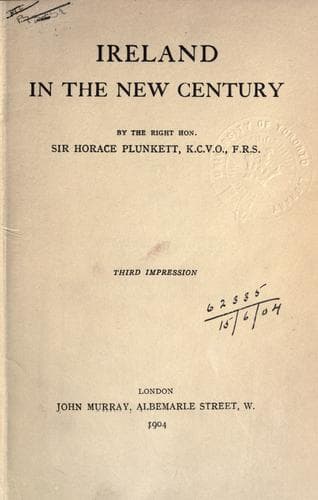
Ireland In The New CenturyPlunkett, Horace Curzon, Sir
History
Ireland In The New Century
Plunkett, Horace Curzon, Sir
Ireland -- Economic conditions; Ireland -- Politics and government -- 1901-1910; Irish question
I feel some hesitation in asking the reader to believe that a great and
lasting revolution in Irish thought has been brought about in such a
moment in the life of a people as twelve short years. But a lesser
number of months seemed to the English mind adequate for the
accomplishment of the change. And what a change it was that they
conceived! To them, less than a year ago, the Irish Question was not
merely unsolved, but in its essential features appeared unaltered. After
seven centuries of experimental statecraft--so varied that the English
could not believe any expedient had yet to be tried--the vast majority
of the Irish people regarded the Government as alien, disputed the
validity of its laws, and felt no responsibility for administration, no
respect for the legislature, or for those who executed its decrees. And
this in a country forming an integral part of the United Kingdom, where
the fundamental basis of government is assumed to be the consent of the
governed! Nor were any hopes entertained that the cloud would quickly
pass. During the Boer war the prophets of evil, in predicting the
calamity which was to fall upon the British Empire, took as their text
the failure of English government in Ireland. When they wanted to paint
in the darkest colours the coming heritage of woe, they wrote upon the
wall, 'Another Ireland in South Africa'; and if any exception was taken
to the appropriateness of the phrase, it was certainly not on the
ground that Ireland had ceased to be a warning to British statesmen.
I believe, quite as strongly as the most optimistic Englishman, that
there has been a great change from this state of things in Irish
sentiment, and my explanation of that change, if less dramatic than the
transformation theory, affords more solid ground for optimism. This
change in the sentiment of Irishmen towards England is due, not to a
sudden emotion of the incomprehensible Celt, but really to the
opinion--rapidly growing for the last dozen years--that great as is the
responsibility of England for the state of Ireland, still greater is the
responsibility of Irishmen. The conviction has been more and more borne
in upon the Irish mind that the most important part of the work of
regenerating Ireland must necessarily be done by Irishmen in Ireland.
The result has been that many Irishmen, both Unionists and Nationalists,
without in any way abandoning their opposition to, or support of, the
attempt to solve the political problem from without, have been
trying--not without success--to solve some part of the Irish Question
from within. The Report of the Recess Committee, on which I shall dwell
later, was the first great fruit of this movement, and the Dunraven
Treaty, which paved the way for Mr. Wyndham's Land Act, was a further
fruit, and not the result of an inexplicable transformation scene.
Public-domain text, read in full here on John Shaqi.
Reviews
Reviews
No reviews yet
Be the first to share your thoughts on this work.
Join the Discussion
Join the discussion
Sign in to leave a comment or review.
Sign InorCreate an account