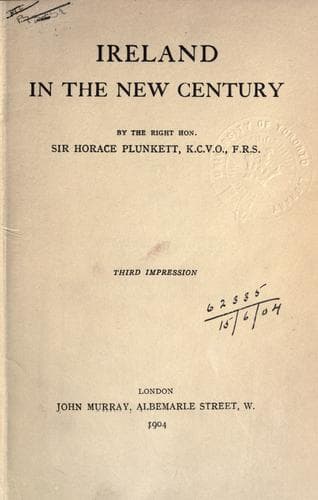
Ireland In The New CenturyPlunkett, Horace Curzon, Sir
History
Ireland In The New Century
Plunkett, Horace Curzon, Sir
Ireland -- Economic conditions; Ireland -- Politics and government -- 1901-1910; Irish question
The reason why I dwell on the true nature of the undoubted change in
the Irish situation is not in order to exaggerate the importance of the
part played by the new movement in bringing it about, nor to detract
from the importance of Parliamentary action, but because a mistaken view
of the change would inevitably postpone the firm establishment of an
improved mutual understanding between the two countries, which I regard
as an essential of Irish progress. I confess that my apprehension of a
new misunderstanding was aroused by the debates on the Land Bill in the
House of Commons. As regards the spirit of conciliation and moderation
displayed by the Irish, and the sincere desire exhibited by the British
to heal the chief Irish economic sore, the speeches were, if not
epoch-making, at any rate epoch-marking; but they showed little sense of
perspective or proportion in viewing the Irish Question, and little
grasp or appreciation of the large social and economic problems which
the Land Act will bring to the front. Temporary phenomena and
legislative machinery have been endowed with an importance they do not
possess, and miracles, it is supposed, are about to be worked in Ireland
by processes which, whatever rich good may be in them, have never worked
miracles, though they have not seldom excited very similar enthusiasms
in the economic history of other European lands.
I agree, then, with most Englishmen in thinking, though for a different
reason, that the passing of the Land Act marked a new era in Ireland.
They regard it as productive of, or co-incident in time with, the dawn
of the practical in Ireland. I antedate that event by some dozen years,
and regard the Land Act rather as marking a new era, because it removes
the great obstacle which obscured the dawn of the practical for so many,
and hindered it for all.
Whatever may have been the expectations upon which this great measure
was based, I, in common with most Irish observers, watched its progress
with unfeigned delight. The vast majority regarded the hundred millions
of credit and the twelve millions of 'bonus' as a generous concession to
Ireland; and I sympathised with those who deprecated the mischievous
suggestion, not infrequently heard in English political circles, that
this munificence was the 'price of peace.' On one point all were agreed:
the Bill could never have become law had not Mr. Wyndham handled the
Parliamentary situation with masterly tact, temper, and ability. To him
is chiefly due the credit for the fact that the Land Question, in its
old form at any rate, no longer blocks the way, and that the large
problems which remain to be solved, and, above all, the spirit in which
they will have to be approached by those who wish the existing peace to
be the forerunner of material and social progress, can be freely and
frankly discussed.
Public-domain text, read in full here on John Shaqi.
Reviews
Reviews
No reviews yet
Be the first to share your thoughts on this work.
Join the Discussion
Join the discussion
Sign in to leave a comment or review.
Sign InorCreate an account