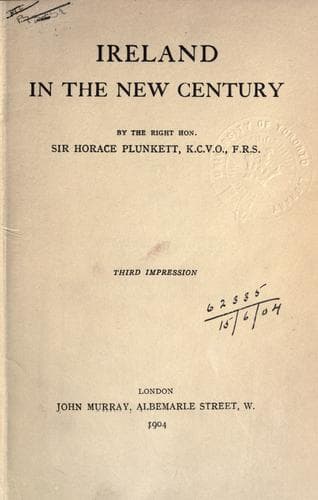
Ireland In The New CenturyPlunkett, Horace Curzon, Sir
History
Ireland In The New Century
Plunkett, Horace Curzon, Sir
Ireland -- Economic conditions; Ireland -- Politics and government -- 1901-1910; Irish question
The Irish land system suffered from the same ills as we all know the
political institutions to have suffered from--a partial and intermittent
conquest. Land holding in Ireland remained largely based on the tribal
system of open fields and common tillage for nearly eight hundred years
after collective ownership had begun to pass away in England. The sudden
imposition upon the Irish, early in the seventeenth century, of a land
system which was no part of the natural development of the country,
ignored, though it could not destroy, the old feeling of communistic
ownership, and, when this vanished, it did not vanish as it did in
countries where more normal conditions prevailed. It did not perish like
a piece of outworn tissue pushed off by a new growth from within: on the
contrary, it was arbitrarily cut away while yet fresh and vital, with
the result that where a bud should have been there was a scar.
This sudden change in the system of land-holding was followed by a
century of reprisals and confiscations, and what war began the law
continued. The Celtic race, for the most part impoverished in mind and
estate by the penal laws, became rooted to the soil, for, as we have
seen, they had, on account of the repression of industries, no
alternative occupation, and so became, in fact, if not in law,
_adscripti glebae_. Upon the productiveness of their labour the
landlord depended for his revenues, but he did little to develop that
productiveness, and the system which was introduced did everything to
lessen it.[3] The wound produced by the original confiscation of the
land was kept from healing by the way in which the tenants' improvements
were somewhat similarly treated. I do not mean that they were
systematically confiscated--the Devon and Bessborough Commissions, as
well as Gladstone, bore witness to the contrary--but the right and the
occasional exercise of the right to confiscate operated in the same way.
In the Irish tenant's mind dispossession was nine-tenths of the law.
Public-domain text, read in full here on John Shaqi.
Reviews
Reviews
No reviews yet
Be the first to share your thoughts on this work.
Join the Discussion
Join the discussion
Sign in to leave a comment or review.
Sign InorCreate an account