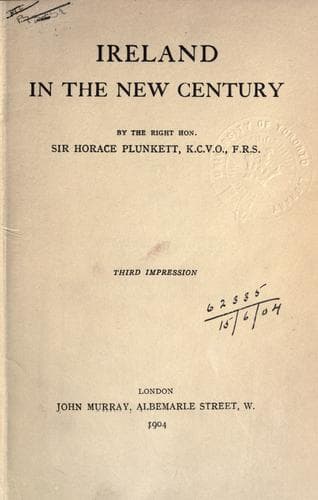
Ireland In The New CenturyPlunkett, Horace Curzon, Sir
History
Ireland In The New Century
Plunkett, Horace Curzon, Sir
Ireland -- Economic conditions; Ireland -- Politics and government -- 1901-1910; Irish question
An enlightened system of land tenure might have made prosperity and
contentment the lot of the native race, and, perhaps, have rendered
possible such a solution of the Irish problem as was effected between
England and Scotland two centuries ago. What was chiefly required for
agrarian peace was a recognition of that sense of partnership in the
land--a relic of the tribal days--to which the Irish mind tenaciously
adhered. But, like most English concessions, it was not granted until
too late, and then granted in the wrong way. The natural result was
that, when at last the recognition of partnership was enacted, it became
a lever for a demand for complete ownership. But this was the aftermath,
for in the meantime, from the seed sown by English blundering,
Ireland--native population and English garrison alike--had reaped the
awful harvest of the Irish famine, which was followed by a long dark
winter of discontent. Upon the England that sowed the wind there was
visited a whirlwind of hostility from the Irish race scattered
throughout the globe.
It would be altogether outside the scope or purpose of this chapter to
present a complete history of the remedial legislation applied to Irish
land tenure. That history, however, illustrates so vividly the English
misunderstanding, that a short survey of one phase of it may help to
point the moral. The English intellect at long last began to grasp the
agrarian, though not the industrial side of the wrong that had been done
to Ireland, and the English conscience was moved; there came the era of
concessions to which I have alluded, and for over a quarter of a century
attempts, often generous, if not very discriminating, were made to deal
with the situation. In 1870, dispossession was made very costly to the
landlord. In 1881, it became impossible, except on the tenant's default,
and the partnership was fully recognised, the tenant's share being made
his own to sell, and being preserved for his profitable use by a right
to have the rent payable to his sleeping partner, the landlord, fixed by
a judicial tribunal. These rights were the famous three F's--fixity of
tenure, free sale, and fair rent--of the Magna Charta of the Irish
peasant. If these concessions had only been made in time, they would
probably have led to a strengthening of the economic position and
character of the Irish tenantry, which would have enabled them to take
full advantage of their new status, and meet any condition which might
arise; and it is just possible that the system might have worked well,
even at the eleventh hour, had it been launched on a rising market.
Unhappily, it fell upon evil days. The prosperous times of Irish
agriculture, which culminated a few years before the passing of the
'Tenants' Charter,' were followed by a serious reaction, the result of
causes which, though long operative, were only then beginning to make
themselves felt, and some of which, though the fact was not then
Public-domain text, read in full here on John Shaqi.
Reviews
Reviews
No reviews yet
Be the first to share your thoughts on this work.
Join the Discussion
Join the discussion
Sign in to leave a comment or review.
Sign InorCreate an account