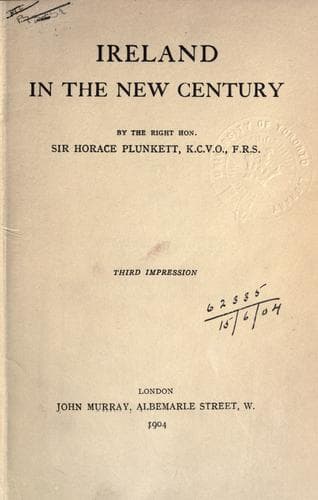
Ireland In The New CenturyPlunkett, Horace Curzon, Sir
History
Ireland In The New Century
Plunkett, Horace Curzon, Sir
Ireland -- Economic conditions; Ireland -- Politics and government -- 1901-1910; Irish question
I may now conclude my appeal to outside observers for a broader and more
philosophic view of my country and my countrymen with a suggestion born
of my own early mistakes, and with a word of warning which is called for
by my later observation of the mistakes of others. The difficulty of the
outside observer in understanding the Irish Question is, no doubt,
largely due to the fact that those in intimate touch with the actual
conditions are so dominated by vehement and passionate conviction that
reason is not only at a discount but is fatal to the acquisition of
popular influence. Of course the power of knowledge and thought, though
kept in the background, is not really eliminated. But it is in the
circumstances not unnatural that most of us should fall into the error
of attributing to the influence of prominent individuals or
organisations the events and conditions which the superficial observer
regards as the creation of the hour, but which are in reality the
outcome of a slow and continuous process of evolution. I remember as a
boy being captivated by that charming corrective to this view of
historical development, Buckle's _History of Civilization_, which in
recent years has often recurred to my mind, despite the fact that many
of his theories are now somewhat discredited. Buckle, if I remember
right, almost eliminates the personal factor in the life of nations.
According to his theory, it would not have made much difference to
modern civilisation if Napoleon had happened, as was so near being the
case, to be born a British instead of a French subject. It would also
have followed that if O'Connell had limited his activities to his
professional work, or if Parnell had chanced to hate Ireland as bitterly
as he hated England, we should have been, politically, very much where
we are to-day. The student of Irish affairs should, of course, avoid the
extreme views of historical causation; but in the search for the truth
he will, I think, be well advised to attach less significance to the
influence of prominent personality than is the practice of the ordinary
observer in Ireland.
Public-domain text, read in full here on John Shaqi.
Reviews
Reviews
No reviews yet
Be the first to share your thoughts on this work.
Join the Discussion
Join the discussion
Sign in to leave a comment or review.
Sign InorCreate an account