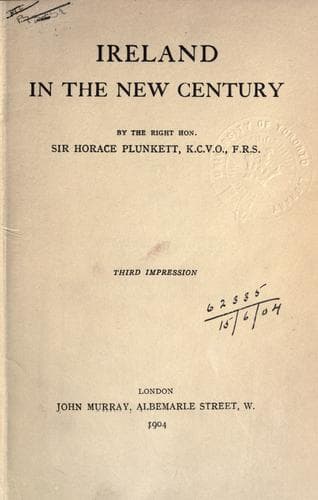
Ireland In The New CenturyPlunkett, Horace Curzon, Sir
History
Ireland In The New Century
Plunkett, Horace Curzon, Sir
Ireland -- Economic conditions; Ireland -- Politics and government -- 1901-1910; Irish question
The warning I have to offer, I think, will be justified by a reflection
upon the history of the panaceas which we have been offered, and upon
our present state. To those of my British readers who honestly desire to
understand the Irish Question, I would say, let them eschew the sweeping
generalisations by which Irish intelligence is commonly outraged. I may
pass by the explanation which rests upon the cheap attribution of racial
inferiority with the simple reply that our inferior race has much of the
superior blood in its veins; yet the Irish problem is just as acute in
districts where the English blood predominates as where the people are
'mere Irish.' If this view be disputed, the matter is not worth arguing
about, because we cannot be born again. But there are three other common
explanations of the Irish difficulty, any one of which taken by itself
only leads away from the truth. I refer, I need hardly say, to the
familiar assertions that the origin of the evil is political, that it is
religious, or that it is neither one nor the other, but economic. In
Irish history, no doubt, we may find, under any of these heads, cause
enough for much of our present wrong-goings. But I am profoundly
convinced that each of the simple explanations to which I have just
alluded--the racial, the political, the religious, the economic--is
based upon reasoning from imperfect knowledge of the facts of Irish
life. The cause and cure of Irish ills are not chiefly political,
broaden or narrow our conception of politics as we will; they are not
chiefly religious, whatever be the effect of Roman Catholic influence
upon the practical side of the people's life; they are not chiefly
economic, be the actual poverty of the people and the potential wealth
of the country what they may. The Irish Question is a broad and deeply
interesting human problem which has baffled generation after generation
of a great and virile race, who complacently attribute their incapacity
to master it to Irish perversity, and pass on, leaving it unsolved by
Anglo-Saxons, and therefore insoluble!
FOOTNOTES:
[1] My own experience confirms Mr. Lecky's view of the chief cause of
this extraordinary feeling. "It is probable," he writes, "that the true
source of the savage hatred of England that animates great bodies of
Irishmen on either side of the Atlantic has very little real connection
with the penal laws, or the rebellion, or the Union. It is far more due
to the great clearances and the vast unaided emigrations that followed
the famine."--_Leaders of Public Opinion in Ireland_, Vol. II., p, 177.
[2] _Spectator_, 6th September, 1902.
[3] The title to the greater part of Irish land is based on
confiscation. This is true of many other countries, but what was
exceptional in the Irish confiscations was that the grantees for the
most part did not settle on the lands themselves, drive away the
dispossessed, or come to any rational working agreement with them.
CHAPTER II.
Public-domain text, read in full here on John Shaqi.
Reviews
Reviews
No reviews yet
Be the first to share your thoughts on this work.
Join the Discussion
Join the discussion
Sign in to leave a comment or review.
Sign InorCreate an account