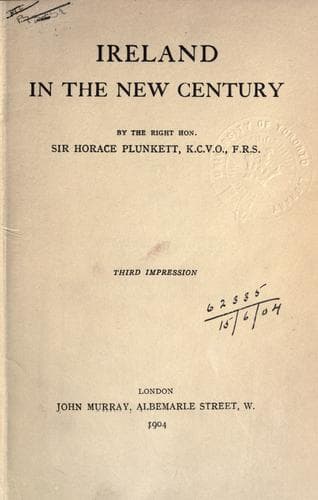
Ireland In The New CenturyPlunkett, Horace Curzon, Sir
History
Ireland In The New Century
Plunkett, Horace Curzon, Sir
Ireland -- Economic conditions; Ireland -- Politics and government -- 1901-1910; Irish question
THE IRISH QUESTION IN IRELAND.
Whilst attributing the long continued failure of English rule in Ireland
largely to a misunderstanding of the Irish mind, I have given
England--at least modern England--credit for good intentions towards us.
I now come to the case of the misunderstood, and shall from henceforth
be concerned with the immeasurably greater responsibility of the Irish
people themselves for their own welfare. The most characteristic, and by
far the most hopeful feature of the change in the Anglo-Irish situation
which took place in the last decade of the nineteenth century, and upon
the meaning of which I dwelt in the preceding chapter, is the growing
sense amongst us that the English misunderstanding of Ireland is of far
less importance, and perhaps less inexcusable, than our own
misunderstanding of ourselves.
When I first came into practical touch with the extraordinarily complex
problems of Irish life, nothing impressed me so much as the universal
belief among my countrymen that Providence had endowed them with
capacities of a high order, and their country with resources of
unbounded richness, but that both the capacities and the resources
remained undeveloped owing to the stupidity--or worse--of British rule.
It was asserted, and generally taken for granted, that the exiles of
Erin sprang to the front in every walk of life throughout the world, in
every country but their own--though I notice that in quite recent times
endeavours have been made to cool the emigration fever by painting the
fortunes of the Irish in America in the darkest colours. To suggest that
there was any use in trying at home to make the best of things as they
were was indicative of a leaning towards British rule; and to attempt to
give practical effect to such a heresy was to draw a red herring across
the path of true Nationalism.
It is not easy to account for the long continuance of this attitude of
the Irish mind towards Irish problems, which seems unworthy of the
native intelligence of the people. The truth probably is that while we
have not allowed our intellectual gifts to decay, they have been of
little use to us because we have neglected the second part of the old
Scholastic rule of life, and have failed to develop the moral qualities
in which we are deficient. Hence we have developed our critical
faculties, not, unhappily, along constructive lines. We have been
throughout alive to the muddling of our affairs by the English, and have
accurately gauged the incapacity of our governors to appreciate our
needs and possibilities. But we recognised their incapacity more readily
than our own deficiencies, and we estimated the failure of the English
far more justly than we apportioned the responsibility between our
rulers and ourselves. The sense of the duty and dignity of labour has
been lost in the contemplation of circumstances over which it was
assumed that we have no control.
Public-domain text, read in full here on John Shaqi.
Reviews
Reviews
No reviews yet
Be the first to share your thoughts on this work.
Join the Discussion
Join the discussion
Sign in to leave a comment or review.
Sign InorCreate an account