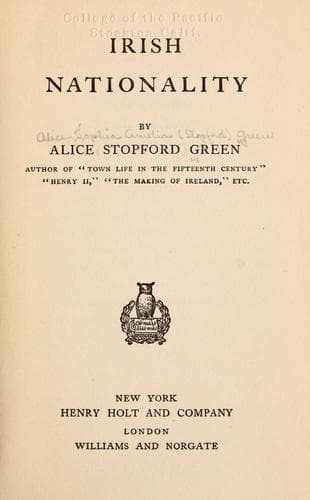
Ireland -- History; Ireland -- Politics and government; Irish question
It is in this exaltation of learning in the national life that we must
look for the real significance of Irish history--the idea of a society
loosely held in a political sense, but bound together in a spiritual
union. The assemblies which took place in every province and every
petty state were the guarantees of the national civilization. They were
periodical exhibitions of everything the people esteemed--democracy,
aristocracy, king-craft, literature, tradition, art, commerce, law,
sport, religion, display, even rustic buffoonery. The years between one
festival and another were spent in serious preparation for the next; a
multitude of maxims were drawn up to direct the conduct of the people.
So deeply was their importance felt that the Irish kept the tradition
diligently, and even in the darkest times of their history, down to the
seventeenth century, still gathered to "meetings on hills" to exercise
their law and hear their learned men.
In the time of the Roman Empire, therefore, the Irish looked on
themselves as one race, obedient to one law, united in one culture and
belonging to one country. Their unity is symbolised by the great
genealogical compilations in which all the Gaels are traced to one
ancestry, and in the collections of topographical legends dealing with
hundreds of places, where every nook and corner of the island is
supposed to be of interest to the whole of Ireland. The tribal
boundaries were limits to the material power of a chief and to that
only: they were no barriers to the national thought or union. The
learned man of the clan was the learned man of the Gaelic race. By all
the higher matters of language and learning, of equity and history,
the people of Ireland were one. A noble figure told the unity of
their land within the circuit of the ocean. The Three Waves of Erin,
they said, smote upon the shore with a foreboding roar when danger
threatened the island; Cleena's wave called to Munster at an inlet
near Cork, while Tonn Rury at Dundrum and Tonn Tuaithe at the mouth of
the Bann sounded to the men of Ulster.
Public-domain text, read in full here on John Shaqi.
Reviews
Reviews
No reviews yet
Be the first to share your thoughts on this work.
Join the Discussion
Join the discussion
Sign in to leave a comment or review.
Sign InorCreate an account