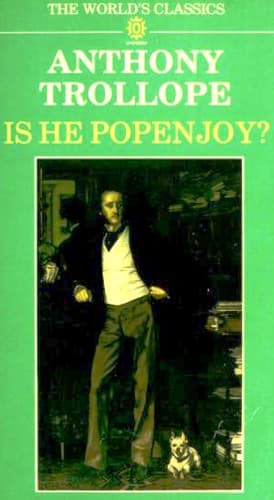
Domestic fiction; Inheritance and succession -- Fiction
He was a man whom no one could despise, and in whom few could find much
to blame. In the first place he looked his poverty in the face, and
told himself that he was a very poor man. His bread he might earn by
looking after his mother and sisters, and he knew no other way in
which he could do so. He was a just steward, spending nothing to
gratify his own whims, acknowledging on all sides that he had nothing
of his own, till some began to think that he was almost proud of his
poverty. Among the ladies of the family, his mother and sisters, it was
of course said that George must marry money. In such a position there
is nothing else that the younger son of a marquis can do. But Lord
George was a person somewhat difficult of instruction in such a matter.
His mother was greatly afraid of him. Among his sisters Lady Sarah
alone dared to say much to him; and even to her teaching on this
subject he turned a very deaf ear. "Quite so, George," she said; "quite
so. No man with a spark of spirit would marry a woman for her
money,"--and she laid a great stress on the word "for,"--"but I do not
see why a lady who has money should be less fit to be loved than one
who has none. Miss Barm is a most charming young woman, of excellent
manners, admirably educated, if not absolutely handsome, quite of
distinguished appearance, and she has forty thousand pounds. We all
liked her when she was here." But there came a very black frown upon
Lord George's brow, and then even Lady Sarah did not dare to speak
again in favour of Miss Barm.
Then there came a terrible blow. Lord George Germain was in love with
his cousin, Miss De Baron! It would be long to tell, and perhaps
unnecessary, how that young lady had made herself feared by the ladies
of Manor Cross. Her father, a man of birth and fortune, but not perhaps
with the best reputation in the world, had married a Germain of the
last generation, and lived, when in the country, about twenty miles
from Brotherton. He was a good deal on the turf, spent much of his time
at card-playing clubs, and was generally known as a fast man. But he
paid his way, had never put himself beyond the pale of society, and
was, of course, a gentleman. As to Adelaide de Baron, no one doubted
her dash, her wit, her grace, or her toilet. Some also gave her credit
for beauty; but there were those who said that, though she would behave
herself decently at Manor Cross and houses of that class, she could be
loud elsewhere. Such was the lady whom Lord George loved, and it may be
conceived that this passion was distressing to the ladies of Manor
Cross. In the first place, Miss De Baron's fortune was doubtful and
could not be large; and then--she certainly was not such a wife as Lady
Brotherton and her daughters desired for the one male hope of the
family.
Public-domain text, read in full here on John Shaqi.
Reviews
Reviews
No reviews yet
Be the first to share your thoughts on this work.
Join the Discussion
Join the discussion
Sign in to leave a comment or review.
Sign InorCreate an account