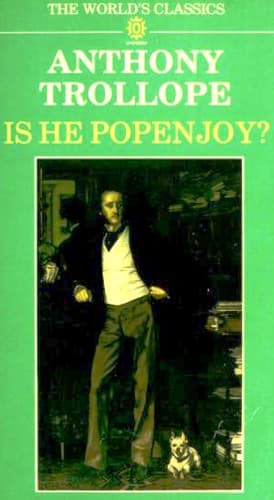
Domestic fiction; Inheritance and succession -- Fiction
But Lord George was very resolute, and for a time it seemed to them all
that Miss de Baron,--of whom the reader will see much if he go through
with our story,--was not unwilling to share the poverty of her noble
lover. Of Lord George personally something must be said. He was a tall,
handsome, dark-browed man, silent generally and almost gloomy, looking,
as such men do, as though he were always revolving deep things in his
mind, but revolving in truth things not very deep,--how far the money
would go, and whether it would be possible to get a new pair of
carriage-horses for his mother. Birth and culture had given to him a
look of intellect greater than he possessed; but I would not have it
thought that he traded on this or endeavoured to seem other than he
was. He was simple, conscientious, absolutely truthful, full of
prejudices, and weak-minded. Early in life he had been taught to
entertain certain ideas as to religion by those with whom he had lived
at college, and had therefore refused to become a clergyman. The bishop
of the diocese had attacked him; but, though weak, he was obstinate.
The Dean and he had become friends, and so he had learned to think
himself in advance of the world. But yet he knew himself to be a
backward, slow, unappreciative man. He was one who could bear reproach
from no one else, but who never praised himself even to himself.
But we must return to his love, which is that which now concerns us.
His mother and sisters altogether failed to persuade him. Week after
week he went over to Baronscourt, and at last threw himself at
Adelaide's feet. This was five years after his father's death, when he
was already thirty years old. Miss De Baron, though never a favourite
at Manor Cross, knew intimately the history of the family. The present
marquis was over forty, and as yet unmarried;--but then Lord George was
absolutely a pauper. In that way she might probably become a
marchioness; but then of what use would life be to her, should she be
doomed for the next twenty years to live simply as one of the ladies of
Manor Cross? She consulted her father, but he seemed to be quite
indifferent, merely reminding her that though he would be ready to do
everything handsomely for her wedding, she would have no fortune till
after his death. She consulted her glass, and told herself that,
without self-praise, she must regard herself as the most beautiful
woman of her own acquaintance. She consulted her heart, and found that
in that direction she need not trouble herself. It would be very nice
to be a marchioness, but she certainly was not in love with Lord
George. He was handsome, no doubt--very handsome; but she was not sure
that she cared much for men being handsome. She liked men that "had
some go in them," who were perhaps a little fast, and who sympathised
with her own desire for amusement. She could not bring herself to fall
in love with Lord George. But then, the rank of a marquis is very high!
Public-domain text, read in full here on John Shaqi.
Reviews
Reviews
No reviews yet
Be the first to share your thoughts on this work.
Join the Discussion
Join the discussion
Sign in to leave a comment or review.
Sign InorCreate an account