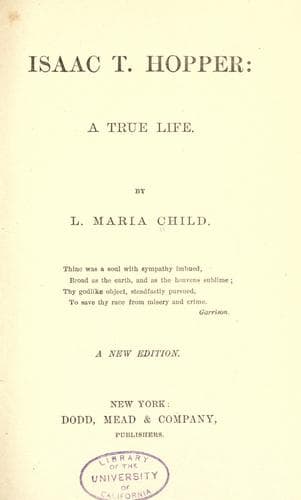
Fugitive slaves -- United States; Hopper, Isaac T. (Isaac Tatem), 1771-1852
They were married on the eighteenth of the Ninth Month, [September,]
1795; he being nearly twenty-four years of age, and she about three
years younger. The worldly comforts which a kind Providence bestowed on
Isaac and his bride, were freely imparted to others. The resolution
formed after listening to the history of old Mingo's wrongs was pretty
severely tested by a residence in Philadelphia. There were numerous
kidnappers prowling about the city, and many outrages were committed,
which would not have been tolerated for a moment toward any but a
despised race. Pennsylvania being on the frontier of the slave states,
runaways were often passing through; and the laws on that subject were
little understood, and less attended to. If a colored man was arrested
as a fugitive slave, and discharged for want of proof, the magistrate
received no fee; but if he was adjudged a slave, and surrendered to his
claimant, the magistrate received from five to twenty dollars for his
trouble; of course, there was a natural tendency to make the most of
evidence in favor of slavery.
Under these circumstances, the Pennsylvania Abolition Society was
frequently called upon to protect the rights of colored people. Isaac T.
Hopper became an active and leading member of this association. He was
likewise one of the overseers of a school for colored children,
established by Anthony Benezet; and it was his constant practice, for
several years, to teach two or three nights every week, in a school for
colored adults, established by a society of young men. In process of
time, he became known to everybody in Philadelphia as the friend and
legal adviser of colored people upon all emergencies. The shrewdness,
courage, and zeal, with which he fulfilled this mission will be seen in
the course of the following narratives, which I have selected from a
vast number of similar character, in which he was the principal agent.
CHARLES WEBSTER.
In 1797, a wealthy gentleman from Virginia went to spend the winter in
Philadelphia, accompanied by his wife and daughter. He had a slave named
Charles Webster, whom he took with him as coachman and waiter. When they
had been in the city a few weeks, Charles called upon Isaac T. Hopper,
and inquired whether he had become free in consequence of his master's
bringing him into Pennsylvania. It was explained to him, that if he
remained there six months, with his master's knowledge and consent, he
would then be a free man, according to the laws of Pennsylvania. The
slave was quite disheartened by this information; for he supposed his
owner was well acquainted with the law, and would therefore be careful
to take him home before that term expired.
"I am resolved never to return to Virginia," said he. "Where can I go to
be safe?"
Public-domain text, read in full here on John Shaqi.
Reviews
Reviews
No reviews yet
Be the first to share your thoughts on this work.
Join the Discussion
Join the discussion
Sign in to leave a comment or review.
Sign InorCreate an account