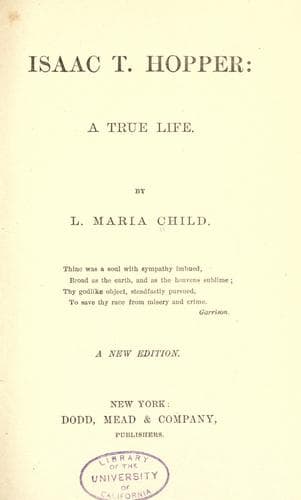
Fugitive slaves -- United States; Hopper, Isaac T. (Isaac Tatem), 1771-1852
Friend Hopper told him his master might be ignorant of the law, or
forgetful of it. He advised him to remain with the family until he saw
them making preparations to return. If the prescribed six months expired
meanwhile, he would be a free man. If not, there would be time enough to
consult what had better be done. "It is desirable to obtain thy liberty
in a legal way, if possible," said he; "for otherwise thou wilt be
constantly liable to be arrested, and may never again have such a good
opportunity to escape from bondage."
Charles hesitated, but finally concluded to accept this prudent advice.
The time seemed very long to the poor fellow; for he was in a continual
panic lest his master should take him back to Virginia; but he did his
appointed tasks faithfully, and none of the family suspected what was
passing in his mind.
The long-counted six months expired at last; and that very day, his
master said, "Charles, grease the carriage-wheels, and have all things
in readiness; for I intend to start for home to-morrow."
The servant appeared to be well pleased with this prospect, and put the
carriage and harness in good order. As soon as that job was completed,
he went to Friend Hopper and told him the news. When assured that he was
now a free man, according to law, he could hardly be made to believe it.
He was all of a tremor with anxiety, and it seemed almost impossible to
convince him that he was out of danger. He was instructed to return to
his master till next morning, and to send word by one of the hotel
servants in case he should be arrested meanwhile.
The next morning, he again called upon Friend Hopper, who accompanied
him to the office of William Lewis, a highly respectable lawyer, who
would never take any fee for his services on such occasions. When Mr.
Lewis heard the particulars of the case, he wrote a polite note to the
Virginian, informing him that his former slave was now free, according
to the laws of Pennsylvania; and cautioning him against any attempt to
take him away, contrary to his own inclination.
The lawyer advised Friend Hopper to call upon the master and have some
preparatory conversation with him, before Charles was sent to deliver
the note. He was then, only twenty-six years of age, and he felt
somewhat embarrassed at the idea of calling upon a wealthy and
distinguished stranger, who was said to be rather imperious and
irritable. However, after a little reflection, he concluded it was his
duty, and accordingly he did it.
Public-domain text, read in full here on John Shaqi.
Reviews
Reviews
No reviews yet
Be the first to share your thoughts on this work.
Join the Discussion
Join the discussion
Sign in to leave a comment or review.
Sign InorCreate an account