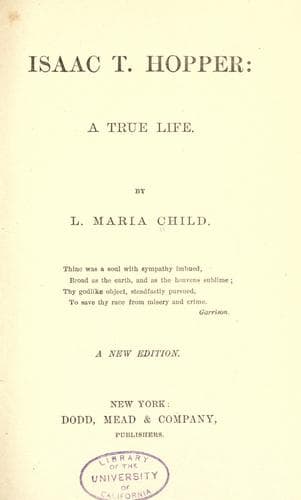
Fugitive slaves -- United States; Hopper, Isaac T. (Isaac Tatem), 1771-1852
When the Southerner was informed that his servant was free, and that a
lawyer had been consulted on the subject, he was extremely angry, and
used very contemptuous language concerning people who tampered with
gentlemen's servants. The young Quaker replied, "If thy son were a slave
in Algiers, thou wouldst thank me for tampering with _him_ to procure
his liberty. But in the present case, I am not obnoxious to the charge
thou hast brought; for thy servant came of his own accord to consult me,
I merely made him acquainted with his legal rights; and I intend to see
that he is protected in them."
When Charles delivered the lawyers note, and his master saw that he no
longer had any legal power over him, he proposed to hire him to drive
the carriage home. But Charles was very well aware that Virginia would
be a very dangerous place for him, and he positively refused. The
incensed Southerner then claimed his servant's clothes as his property,
and ordered him to strip instantly. Charles did as he was ordered, and
proceeded to walk out of the room naked. Astonished to find him willing
to leave the house in that condition, he seized him violently, thrust
him back into the room, and ordered him to dress himself. When he had
assumed his garments, he walked off; and the master and servant never
met again.
Charles was shrewd and intelligent, and conducted himself in such a
manner as to gain respect. He married an industrious, economical woman,
who served in the family of Chief Justice Tilghman. In process of time,
he built a neat two-story house, where they brought up reputably a
family of fourteen children, who obtained quite a good education at the
school established by Anthony Benezet.
BEN JACKSON.
Ben was born a slave in Virginia. When he was about sixteen years old,
his mind became excited on the subject of slavery. He could not
reconcile it with the justice and goodness of the Creator, that one man
should be born to toil for another without wages, to be driven about,
and treated like a beast of the field. The older he grew, the more
heavily did these considerations press upon him. At last, when he was
about twenty-five years old, he resolved to gain his liberty, if
possible. He left his master, and after encountering many difficulties,
arrived in Philadelphia, where he let himself on board a vessel and went
several voyages. When he was thirty years of age, he married, and was
employed as a coachman by Dr. Benjamin Rush, one of the signers of the
Declaration of Independence. He lived with him two years; and when he
left, Dr. Rush gave him a paper certifying that he was a free man,
honest, sober, and capable.
Public-domain text, read in full here on John Shaqi.
Reviews
Reviews
No reviews yet
Be the first to share your thoughts on this work.
Join the Discussion
Join the discussion
Sign in to leave a comment or review.
Sign InorCreate an account