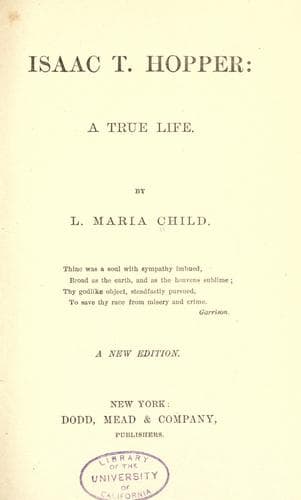
Fugitive slaves -- United States; Hopper, Isaac T. (Isaac Tatem), 1771-1852
When Friend Hopper went home, he found him at his house. He tried to
impress upon his mind the peril he would incur by remaining in
Philadelphia, and advised him by all means to go to sea. But his wife
was strongly attached to him, and so unwilling to consent to this plan,
that he concluded to run the risk of staying with her. He remained
concealed about a week, and then returned to the house he had previously
occupied. They lived in the second story, and there was a shed under
their bed-room window. Ben placed a ladder under the window, to be ready
for escape; but it was so short, that it did not reach the roof of the
shed by five or six feet. His wife was an industrious, orderly woman,
and kept their rooms as neat as a bee-hive. The only thing which marred
their happiness was the continual dread that man-hunters might pounce
upon them, in some unguarded hour, and separate them forever. About a
fortnight after his arrest, they were sitting together in the dusk of
the evening, when the door was suddenly burst open, and his master
rushed in with a constable. Ben sprang out of the window, down the
ladder, and made his escape. His master and the constable followed; but
as soon as they were on the ladder, Ben's wife cut the cord that held
it, and they tumbled heels over head upon the shed. This bruised them
some, and frightened them still more. They scrambled upon their feet,
cursing at a round rate.
Ben arrived safely at the house of Isaac T. Hopper, who induced him to
quit the city immediately, and go to sea. His first voyage was to the
East Indies. While he was gone, Friend Hopper negotiated with the
master, who, finding there was little chance of regaining his slave,
agreed to manumit him for one hundred and fifty dollars. As soon as Ben
returned, he repaid from his wages the sum which had been advanced for
his ransom. His wife's health was greatly impaired by the fear and
anxiety she had endured on his account. She became a prey to melancholy,
and never recovered her former cheerfulness.
THOMAS COOPER.
The person who assumed this name was called Notly, when he was a slave
in Maryland. He was compelled to labor very hard, was scantily supplied
with food and clothing, and lodged in a little ricketty hut, through
which the cold winds of winter whistled freely. He was of a very
religious turn of mind, and often, when alone in his little cabin at
midnight, he prayed earnestly to God to release him from his
sufferings.
Public-domain text, read in full here on John Shaqi.
Reviews
Reviews
No reviews yet
Be the first to share your thoughts on this work.
Join the Discussion
Join the discussion
Sign in to leave a comment or review.
Sign InorCreate an account