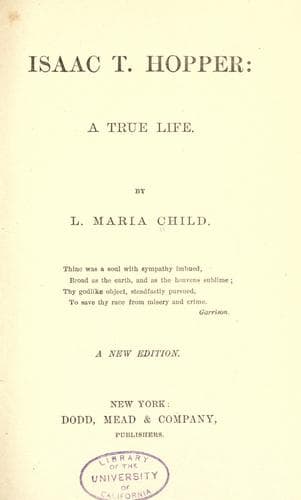
Fugitive slaves -- United States; Hopper, Isaac T. (Isaac Tatem), 1771-1852
In the year 1800, he found a favorable opportunity to escape from his
unfeeling master, and made his way to Philadelphia, where he procured
employment in a lumber-yard, under the name of John Smith. He was so
diligent and faithful, that he soon gained the good-will and confidence
of his employers. He married a worthy, industrious woman, with whom he
lived happily. By their united earnings they were enabled to purchase a
small house, where they enjoyed more comfort than many wealthy people,
and were much respected by neighbors and acquaintances.
Unfortunately, he confided his story to a colored man, who, for the sake
of reward, informed his master where he was to be found. Accordingly, he
came to Philadelphia, arrested him, and carried him before a magistrate.
Having brought forward satisfactory evidence that he was a slave, an
order was granted to carry him back to Maryland. Isaac T. Hopper was
present at this decision, and was afflicted by it beyond measure. John's
employers pitied his condition, and sympathized with his afflicted wife
and children. They offered to pay a large sum for his ransom; but his
savage master refused to release him on any terms. This sober,
industrious man, guiltless of any crime, was hand-cuffed and had his
arms tied behind him with a rope, to which another rope was appended,
for his master to hold. While they were fastening his fetters, he spoke
a few affectionate words to his weeping wife. "Take good care of the
children," said he; "and don't let them forget their poor father. If you
are industrious and frugal, I hope you will be enabled to keep them at
school, till they are old enough to be placed at service in respectable
families. Never allow them to be idle; for that will lead them into bad
ways. And now don't forget my advice; for it is most likely you will
never see me again."
Then addressing his children, he said, "You will have no father to take
care of you now. Mind what your mother tells you, and be very careful
not to do anything to grieve her. Be industrious and faithful in
whatever you are set about; and never play in the streets with naughty
children."
They all wept bitterly while he thus talked to them; but he restrained
his sobs, though it was evident his heart was well nigh breaking. Isaac
T. Hopper was present at this distressing scene, and suffered almost as
acutely as the poor slave himself. In the midst of his parting words,
his master seized the rope, mounted his horse, snapped his whip, and set
off, driving poor John before him. This was done in a Christian country,
and there was no law to protect the victim.
Public-domain text, read in full here on John Shaqi.
Reviews
Reviews
No reviews yet
Be the first to share your thoughts on this work.
Join the Discussion
Join the discussion
Sign in to leave a comment or review.
Sign InorCreate an account