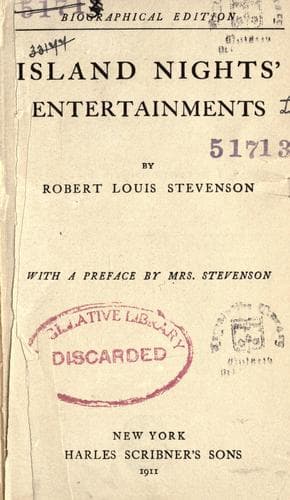
Island Nights' EntertainmentsStevenson, Robert Louis
General
Island Nights' Entertainments
Stevenson, Robert Louis
Islands of the Pacific -- Fiction; Short stories
It seems she was born in one of the Line Islands; had been only two or
three years in these parts, where she had come with a white man, who
was married to her mother and then died; and only the one year in
Falesá. Before that they had been a good deal on the move, trekking
about after the white man, who was one of those rolling stones that
keep going round after a soft job. They talk about looking for gold at
the end of a rainbow; but if a man wants an employment that’ll last him
till he dies, let him start out on the soft-job hunt. There’s meat and
drink in it too, and beer and skittles, for you never hear of them
starving, and rarely see them sober; and as for steady sport,
cock-fighting isn’t in the same county with it. Anyway, this
beachcomber carried the woman and her daughter all over the shop, but
mostly to out-of-the-way islands, where there were no police, and he
thought, perhaps, the soft job hung out. I’ve my own view of this old
party; but I was just as glad he had kept Uma clear of Apia and Papeete
and these flash towns. At last he struck Fale-alii on this island, got
some trade—the Lord knows how!—muddled it all away in the usual style,
and died worth next to nothing, bar a bit of land at Falesá that he had
got for a bad debt, which was what put it in the minds of the mother
and daughter to come there and live. It seems Case encouraged them all
he could, and helped to get their house built. He was very kind those
days, and gave Uma trade, and there is no doubt he had his eye on her
from the beginning. However, they had scarce settled, when up turned a
young man, a native, and wanted to marry her. He was a small chief, and
had some fine mats and old songs in his family, and was “very pretty,”
Uma said; and, altogether, it was an extraordinary match for a
penniless girl and an out-islander.
At the first word of this I got downright sick with jealousy.
“And you mean to say you would have married him?” I cried.
“_Ioe_, yes,” said she. “I like too much!”
“Well!” I said. “And suppose I had come round after?”
“I like you more better now,” said she. “But, suppose I marry Ioane, I
one good wife. I no common Kanaka. Good girl!” says she.
Public-domain text, read in full here on John Shaqi.
Reviews
Reviews
No reviews yet
Be the first to share your thoughts on this work.
Join the Discussion
Join the discussion
Sign in to leave a comment or review.
Sign InorCreate an account