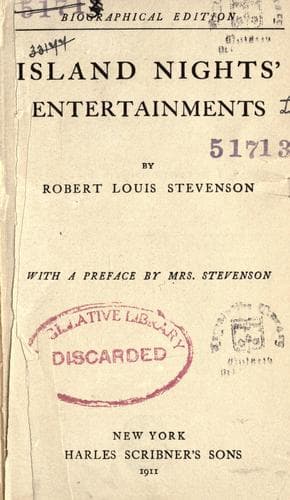
Island Nights' EntertainmentsStevenson, Robert Louis
General
Island Nights' Entertainments
Stevenson, Robert Louis
Islands of the Pacific -- Fiction; Short stories
Well, I had to be pleased with that; but I promise you I didn’t care
about the business one little bit. And I liked the end of that yarn no
better than the beginning. For it seems this proposal of marriage was
the start of all the trouble. It seems, before that, Uma and her mother
had been looked down upon, of course, for kinless folk and
out-islanders, but nothing to hurt; and, even when Ioane came forward,
there was less trouble at first than might have been looked for. And
then, all of a sudden, about six months before my coming, Ioane backed
out and left that part of the island, and from that day to this Uma and
her mother had found themselves alone. None called at their house, none
spoke to them on the roads. If they went to church, the other women
drew their mats away and left them in a clear place by themselves. It
was a regular excommunication, like what you read of in the Middle
Ages; and the cause or sense of it beyond guessing. It was some _tala
pepelo_, Uma said, some lie, some calumny; and all she knew of it was
that the girls who had been jealous of her luck with Ioane used to twit
her with his desertion, and cry out, when they met her alone in the
woods, that she would never be married. “They tell me no man he marry
me. He too much ’fraid,” she said.
The only soul that came about them after this desertion was Master
Case. Even he was chary of showing himself, and turned up mostly by
night; and pretty soon he began to table his cards and make up to Uma.
I was still sore about Ioane, and when Case turned up in the same line
of business I cut up downright rough.
“Well,” I said, sneering, “and I suppose you thought Case ‘very pretty’
and ‘liked too much’?”
“Now you talk silly,” said she. “White man, he come here, I marry him
all-e-same Kanaka; very well then, he marry me all-e-same white woman.
Suppose he no marry, he go ’way, woman he stop. All-e-same thief, empty
hand, Tonga-heart—no can love! Now you come marry me. You big heart—you
no ’shamed island-girl. That thing I love you for too much. I proud.”
I don’t know that ever I felt sicker all the days of my life. I laid
down my fork, and I put away “the island-girl”; I didn’t seem somehow
to have any use for either, and I went and walked up and down in the
house, and Uma followed me with her eyes, for she was troubled, and
small wonder! But troubled was no word for it with me. I so wanted, and
so feared, to make a clean breast of the sweep that I had been.
And just then there came a sound of singing out of the sea; it sprang
up suddenly clear and near, as the boat turned the headland, and Uma,
running to the window, cried out it was “Misi” come upon his rounds.
I thought it was a strange thing I should be glad to have a missionary;
but, if it was strange, it was still true.
“Uma,” said I, “you stop here in this room, and don’t budge a foot out
of it till I come back.”
CHAPTER III.
THE MISSIONARY.
Public-domain text, read in full here on John Shaqi.
Reviews
Reviews
No reviews yet
Be the first to share your thoughts on this work.
Join the Discussion
Join the discussion
Sign in to leave a comment or review.
Sign InorCreate an account