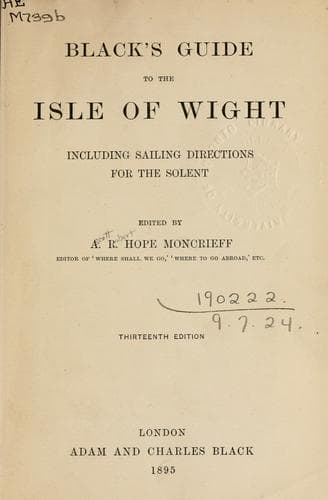
Isle of WightMoncrieff, A. R. Hope (Ascott Robert Hope)
History
Isle of Wight
Moncrieff, A. R. Hope (Ascott Robert Hope)
Isle of Wight (England) -- Description and travel
On the approach by sea, Ryde presents an attractive aspect, displayed as
it is upon a hillside, with its steeply sloping streets, its conspicuous
spires, and its fringe of handsome villas embowered in rich woods that
enclose the town on either side. The most prominent landmark is the
far-seen steeple of the parish Church in the upper part of the town,
built after designs of Sir G. G. Scott, and ornamented with a fine show
of modern art. Beside this stands the Town Hall, beyond which another
church combines a Strawberry Hill Gothic effect, with a light colouring
that at first sight suggests Oriental associations: it might do for a
chapel to the Brighton Pavilion. Ryde has its fair allowance of churches
and chapels of all denominations; but we need not look here for ancient
dignity or picturesqueness, even the parish churches of such modern
resorts as
[Illustration: NEWCHURCH--THE MOTHER CHURCH OF RYDE]
Ryde or Ventnor having been originally chapels of ease to some now
obscure metropolis inland. Georgian solidity or Early Victorian stucco
are the highest notes of antiquity in this smart and cheerful town,
which at the last census, taking in its outskirts, counted 18,000
inhabitants.
Church architecture, it may be said, is not the strongest point of the
Island; though several of its churches have interesting remnants of
Norman work; and I have heard of one native claiming for his parish
steeple an unrecorded antiquity of more than 1600 years, in proof of
which he showed the figures 1620 still legible on the fabric. One of the
most notable ecclesiastical antiquities, Quarr Abbey, lies a pleasant
couple of miles’ walk westward from Ryde. The way is by the adjoining
parish of Binstead, with its modern Church preserving some fragments of
the old one, originally built by the Abbot of Quarr, “because he would
not have all his tenants and the inhabitants of Binstead come to trouble
the Abbey Church.” A gravelled path and a lovers’ lane through a series
of oak copses, giving peeps of the mainland coast, bring one in view of
Quarr Abbey, whose ivied ruins are now to be restored. The name Quarr or
Quarraria is said to come from the Binstead quarries of Upper Eocene
limestone, that figures largely in Winchester Cathedral. The abbey was
founded in the middle of the twelfth century by Baldwin de Redvers, in
fulfilment of a vow made during his banishment for taking Maud’s part
against Stephen, after which his head was lifted up again, so that he
became Lord of the Island and Earl of Devon. He was the first to be
buried here, as later were other persons of note, among them the Lady
Cicely, second daughter of Edward IV., who had married a gentleman of
the Island. Among the numerous traditions attached to the abbey, there
is one that connects a wood called Eleanor’s Grove with the queen of
Henry II., said to have been imprisoned here.
Public-domain text, read in full here on John Shaqi.
Reviews
Reviews
No reviews yet
Be the first to share your thoughts on this work.
Join the Discussion
Join the discussion
Sign in to leave a comment or review.
Sign InorCreate an account