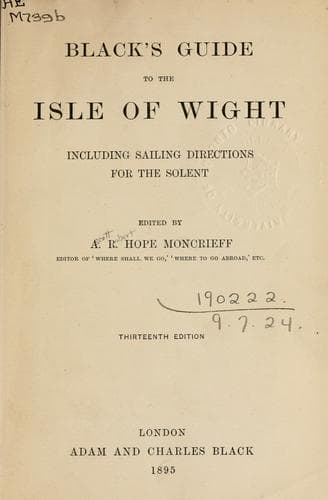
Isle of WightMoncrieff, A. R. Hope (Ascott Robert Hope)
History
Isle of Wight
Moncrieff, A. R. Hope (Ascott Robert Hope)
Isle of Wight (England) -- Description and travel
This was the second Cistercian house established in England, which
before long absorbed so much of the Island, that the Abbot of Quarr
became a petty prince. “Happy was that gentleman that could get his son
to attend upon him,” says Oglander: such offices as treasurer, steward,
chief butler, and rent-gatherer of the abbey being sought by the cadets
of the chief families. But after the Dissolution it soon fell into
decay, monuments and all being sold; and in the beginning of the
seventeenth century, Sir John Oglander found that the very site of the
church had already been forgotten by old men, even by one who remembered
the days of its glory. At this time it had been bought for £3000 by Mr
Fleming, descendant of the Dutch mason brought over from the Low Country
by the founder to carry out the work. “Such,” moralises the knight, “is
the inconstancy of Fortune, which, with the aid of her servant Time,
pulleth down great things and setteth up poor things.”
Since then, the outlines have been more carefully uncovered, or traced,
including part of a wall with which, by license of Edward III., this
abbey was fortified against the attacks of sea-rovers, and of the French
invaders who often assailed the Island. Among the old monuments recorded
by Oglander was one to a “great Monsieur of France” slain here in
Richard II.’s reign. The structure, of which some interesting fragments
remain, was in part adapted as farm buildings, the refectory turned into
a barn. But Quarr has now been bought by the community of French
Benedictines that some years ago crossed the Channel to Appuldurcombe on
the southern downs of the Island; and it is understood that they propose
to restore the abbey as a congenial home. A swarm of nuns of the same
Order has lately settled at Ryde, after a temporary residence at
Northwood, near Cowes. Carisbrooke houses other foreign _religieux_, who
have also a school at Ventnor. Thus the whirligig of time brings about
its revenges, heretic England giving sanctuary to the churchmen of
Catholic France.
Public-domain text, read in full here on John Shaqi.
Reviews
Reviews
No reviews yet
Be the first to share your thoughts on this work.
Join the Discussion
Join the discussion
Sign in to leave a comment or review.
Sign InorCreate an account