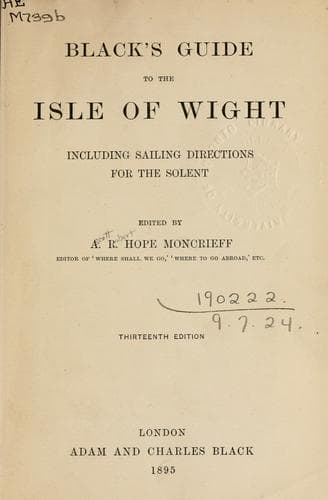
Isle of WightMoncrieff, A. R. Hope (Ascott Robert Hope)
History
Isle of Wight
Moncrieff, A. R. Hope (Ascott Robert Hope)
Isle of Wight (England) -- Description and travel
From Quarr Abbey, one can stroll on to Fishbourne at the mouth of a
creek called the Wootton River, which, a mile or so up, at Wootton
Bridge is crossed by the road from Ryde to Cowes, passing presently
behind the grounds of Osborne. Wootton is another of the oldest Wight
churches, still preserving some features of the time when it was built
by one of the Lisle family (_De l’Ile_) who took their name from this
Island, and gave it to Dame Alice Lisle, the victim of Judge Jeffrey’s
bloody assize. Holding on up the wooded bottom of Wootton River, one
reaches the village of Haven Street, from which an hour’s walk leads
back to the southern outskirts of Ryde, where all but the name of St
John’s Park is now overspread by brick and stone. The way by road gives
a fair notion of the Island scenery on this side; and might be very
pleasantly extended by lanes and field-paths, copses and commons,
seaming and roughening the three mile belt between the sea and the Chalk
Downs to the south.
But the many rambles that may be taken here-abouts are the business of
guide-books; and the high-roads leading out of Ryde need not be pointed
out to its crews of coach excursionists, and to passengers on the motor
omnibuses that start here for different parts of the Island, some faring
as far as Shanklin and Blackgang Chine. For the present let us leave
roads and railways, to stroll along the shore to Seaview, which, at the
north-eastern corner, makes a sort of chapel of ease to Ryde, as
Paignton to Torquay or Westgate to Margate.
This gives another very pleasant hour’s walk, to be taken along the
sea-wall that continues Ryde’s Esplanade. On the land side the way is
much shut in by park woods and castellated villas, but it has an open
view over the Solent, across which at night gleam the myriad lights of
Portsmouth and Southsea; daylight shows this strait enlivened by all
kinds of shipping, and often glorified by the spectacle of a British
fleet, as sometimes by international naval encounters in peace and
courtesy. Our modern ships of war may make a more impressive display,
yet no longer such a picturesque one as when a century ago one visitor
could tell how he saw the whole Channel filled by a convoy, several
hundreds strong, so that “the blue waters in the distance were almost
hidden by the snow-white cloud of sails.” The pictorial place of these
sails, indeed, is often taken by the racing yachts, which run all to
sail; and “a sail is one of the most beautiful things which man ever
invented!” So exclaims Mr George A. B. Dewar, whose “Pageant of the Sea”
papers in the _Saturday Review_ give us Turneresque pictures of this
landlocked waterway:--
Public-domain text, read in full here on John Shaqi.
Reviews
Reviews
No reviews yet
Be the first to share your thoughts on this work.
Join the Discussion
Join the discussion
Sign in to leave a comment or review.
Sign InorCreate an account