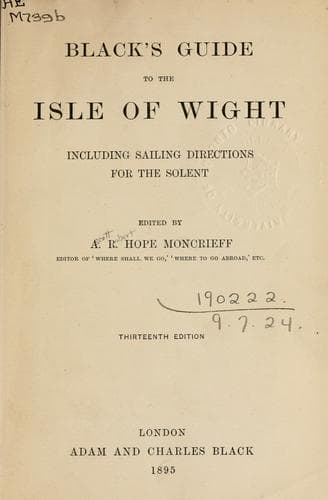
Isle of WightMoncrieff, A. R. Hope (Ascott Robert Hope)
History
Isle of Wight
Moncrieff, A. R. Hope (Ascott Robert Hope)
Isle of Wight (England) -- Description and travel
most beautiful monument is a modern one by Baron Marochetti, to
commemorate Princess Elizabeth, Charles I.’s deformed and sickly
daughter, buried in the old church 1650; but her tomb had been forgotten
till the accidental discovery of the coffin in 1793. She is represented
as found dead by her attendants, according to tradition, with her face
resting on the pages of an open Bible, the gift of her father; and a
happy touch of symbolism shows the iron bars of her life broken by
death. Along with this monument, Queen Victoria contributed two memorial
windows and a medallion of the Prince Consort by the same sculptor.
There is no room for a churchyard in St Thomas’s Square; but across
South Street will be found the old cemetery, close packed with graves.
One, seen from the path leading along it, hints at a story too common a
century ago, an ugly obelisk to the memory of Valentine Gray, “the
little sweep,” erected by public subscription “in testimony of the
general feeling for suffering innocence.” Here is buried John Hamilton
Reynolds, Keats’ friend, and Hood’s brother-in-law, who himself in youth
bid fair to earn poetic fame. He is understood to be part author of
Hood’s _Odes to Great People_; and he was to have collaborated with
Keats in a volume of Italian tales, not to speak of work of his own like
“a runaway ring at Wordsworth’s Peter Bell”; but after penning stanzas
not unsuccessfully, he had the singular fate of taking to engrossing as
a solicitor. He seems to have grown soured or sottish in his later
life, which he ended obscurely as an official of the Newport County
Court.
Of the few old buildings left in Newport, the most remarkable is the
Jacobean Grammar School at the corner of Lugley Street and the road
going down to cross Towngate bridge for Parkhurst and West Cowes. The
old portion, for a later addition has been made, is interesting not only
in itself, but as understood to have housed Charles I. during his last
abortive negotiations with the Parliament, at the end of which the king
was hurried away to his doom. Here, at that day, it was usual to receive
captains and other great men coming into the Island, with an oration
prepared by the schoolmaster and recited by a promising pupil; but one
fears that on his later appearances at Newport poor Charles was somewhat
scrimply treated in the way of loyal addresses.
Public-domain text, read in full here on John Shaqi.
Reviews
Reviews
No reviews yet
Be the first to share your thoughts on this work.
Join the Discussion
Join the discussion
Sign in to leave a comment or review.
Sign InorCreate an account