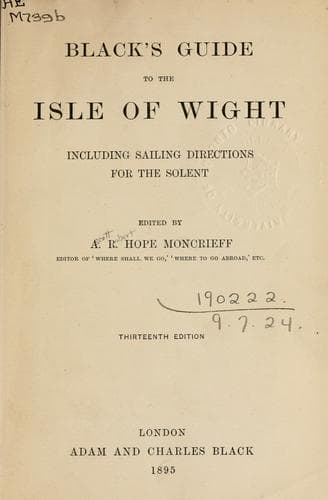
Isle of WightMoncrieff, A. R. Hope (Ascott Robert Hope)
History
Isle of Wight
Moncrieff, A. R. Hope (Ascott Robert Hope)
Isle of Wight (England) -- Description and travel
Visitors to Newport nowadays come mainly for the sake of Carisbrooke
Castle, which is perhaps the chief attraction of the Island, drawing
thousands of excursionists on a holiday occasion. Carisbrooke, at one
time overshadowing the humble beginnings of Newport, is now almost one
of its suburbs, the distance being only a mile or so. From the end of
High Street, the way is by the Mall, a dignified parade that suggests
Bath or Clifton. The road divides at a memorial cross to Sir John
Simeon, Tennyson’s friend and neighbour at Swainston, notable as the
first Catholic to sit in a modern parliament, though he belonged to a
family whose theological associations were expressed by the Simeon Trust
for stocking pulpits with Evangelical divines. Either fork leads to
Carisbrooke, that to the right being the highway for the village, and
the other going more directly to the castle, under a height on which is
the cemetery.
The Windsor of Newport is in itself a place to delight our American
guests, a long, steep village street of true British irregularity,
giving off straggling lanes of rose-wreathed cottages, through which, in
the hollow, flows a clear and shallow brook, bordered by luxuriant
hedges, and by notices of “Teas Provided.” The main thoroughfare,
mounting up to the Church, shows an unusual number of hotels and other
places of entertainment; and the excursion vehicles that rendezvous here
in summer rather disturb the peaceful charm of Carisbrooke, which too
evidently lives on its visitors.
What is left of the Church, originally a double one divided between the
parish and a priory that stood here, still makes a spacious structure,
rearing the best tower in the Island, and enshrining some monuments and
relics, most notable among them the tomb of Sir Nicholas Wadham’s wife,
two generations before the founder of Wadham College. A quaint wooden
tablet recalls the career of William Keeling, one of the earliest of our
East Indian officials, whose name is preserved by the Keeling or Cocos
Islands discovered by him far out in the Indian Ocean, in our time to
be occupied by a Scottish family named Ross, who made this atoll group
into a thriving settlement. The churchyard has a good show of old
tombstones, including a weeping willow, railed in, as fanciful memorial
of a former vicar.
Public-domain text, read in full here on John Shaqi.
Reviews
Reviews
No reviews yet
Be the first to share your thoughts on this work.
Join the Discussion
Join the discussion
Sign in to leave a comment or review.
Sign InorCreate an account