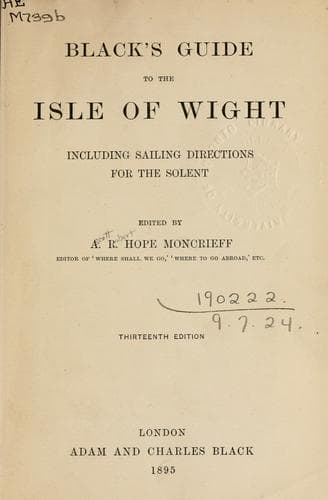
Isle of WightMoncrieff, A. R. Hope (Ascott Robert Hope)
History
Isle of Wight
Moncrieff, A. R. Hope (Ascott Robert Hope)
Isle of Wight (England) -- Description and travel
A late incumbent was the Rev. E. Boucher James, whose Archæological and
Historical Letters made valuable contributions to the annals of the
Island. He does not omit to dig up the buried renown of his predecessor,
the Rev. Alexander Ross, that erudite and voluminous Scot, now
remembered only by the luck of rhyme that made a “sage philosopher” to
have “read Alexander Ross over,” yet by his pen or his preaching, or
somehow, he seems to have gained a considerable fortune, part of which
he left to the poor of Carisbrooke. Any modern reader who cares to
tackle this once-esteemed author, might try a spell at his “Πανσεβεια:
View of all Religions,” which is still to be seen at libraries, if not
on railway bookstalls. Another Carisbrooke worthy commemorated by Mr
James was William Stephens, who, after losing his fortune and his seat
as member for Newport, took part in General Oglethorpe’s philanthropic
plan for settling Georgia, came to be president of the colony, and ended
his life rather miserably in squabbles with the disciples of Whitfield
and other discontented immigrants. Among this learned parson’s records
is the pretty story of Dorothy Osborne, who, travelling with her father
and brother in the days of the Civil War, at an inn hereabouts fell in
with the future Sir William Temple, and the beginning of their courtship
was through one of the young men scrawling on the window some
disrespectful words about the Parliament, which led to the whole party
being haled before the governor, to be released when Dorothy took the
offence on herself: those stern Ironsides did not war against ladies.
More than once the late vicar has to speak of his “friend and
parishioner,” Henry Morley, who here ended the labours on English
literature that made his name well known both in England and America.
Beside the parsonage is a sixpenny show of pavements, and other remains
of a Roman villa unearthed about half a century ago, but since thrown
into the shade by the larger one discovered at Brading. A more recent
sign of Roman invasion is the establishment here of foreign religious
communities, driven by French secularism into this pleasant exile. It is
no common village that clusters about the tower, looking down “from its
centuries of grey calm on the fitful stir and fret around it, and the
fevered hopes and fears that must end at last in the quiet green mounds
at its feet.”
The Castle stands across the valley, where its grey walls, buoyed by a
flagstaff, hardly peep out above the wooded slopes and the thick
greenery that floods the moat. This most picturesquely situated pile
represents a very ancient fortress, held by the Romans, as by ruder
warriors before them, then expanded and strengthened according to the
needs of different times, so as now in its half-dilapidated,
half-restored state, to form a charming medley of ruinous repair,
wreathed with various historic memories, and specially haunted by those
of the last year in which its walls were sternly guarded.
Public-domain text, read in full here on John Shaqi.
Reviews
Reviews
No reviews yet
Be the first to share your thoughts on this work.
Join the Discussion
Join the discussion
Sign in to leave a comment or review.
Sign InorCreate an account