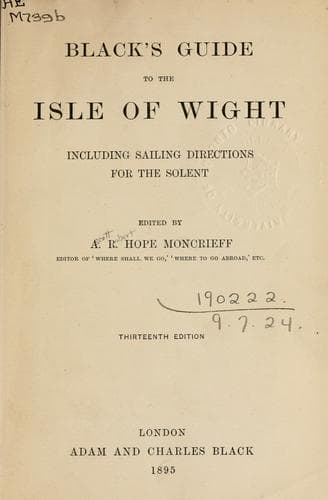
Isle of WightMoncrieff, A. R. Hope (Ascott Robert Hope)
History
Isle of Wight
Moncrieff, A. R. Hope (Ascott Robert Hope)
Isle of Wight (England) -- Description and travel
Carisbrooke has a station, a little to the north, on the Freshwater
line. Beyond this, the westward high-road is edged by a front of dark
firs that mark the enclosure of Parkhurst or Carisbrooke Forest, compact
fragment of a once more extensive woodland, swelling up into eminences
of two or three hundred feet. This is Government property, but ways
through it are open for shady rambles, very pleasant on a hot day. A
field-path from Newport, starting by a footbridge beside a prominent
block of brewery buildings just below the station, leads to the
south-east corner of the forest, where workhouse, prison, and barracks
adjoin one another to make up a little town. Parkhurst Prison, whose
inmates one has seen engaged in the idyllic occupation of haymaking
within a fence of fixed bayonets, ranks as a sort of sanatorium among
our convict depôts, to which delicate criminals are sent rather than to
the bleak heights of Portland or Dartmoor.
The soldiers at the barracks are kept in better order than that Scots
regiment that proved such a curse and corruption to the quiet Wight
parishes in Oglander’s time. He represents them as billeted in the
Island “because they should not run away, being constrained for the most
part to serve contrary to their wills”--_volunteers_, as he elsewhere
calls them “a proud, beggarly nation, and I hope we shall never be
troubled with the like [again], especially the red-shanks, or the
Highlanders, being as barbarous in nature as their clothes.” These
strangers, “insolent by reason of their unanimous holding together,”
brought about so many “inconveniences,” murders, rapes, robberies, and
so forth, that when at length they were shipped off to the siege of La
Rochelle, after being reviewed by Charles on Arreton Down, the worthy
knight can record how “we were free from our Egyptian thraldom, or like
Spain from the Moors, for since the Danish slavery never were these
Islanders so oppressed.” In the outspoken fashion of his day, he notes
how the Scots left behind them a considerable strain of northern blood,
which may have been not altogether an evil for a too closely connected
neighbourhood, where, if all tales are true, marrying in and in has
generated a good deal of physical and mental feebleness.
Keats, who seems to have written part of _Endymion_ at Carisbrooke,
denounces the barracks at Parkhurst as a “nest of debauchery.” But at
the worst, they may have been an Arcadian nook compared to that East
India Company’s recruits depôt near Ryde, described by Scott, in _The
Surgeon’s Daughter_, as a gaol of adventurous scum of society swept
together by crimps and kidnappers. Sir Walter must have visited or at
least coasted “the shore of that beautiful island, which he who once
sees never forgets,” when in 1807 he stayed with his friend Stewart Rose
at Gundimore on the Hampshire coast. Since his day, the Island has seen
various samples of Highland soldiers, and found them not too barbarous
either in dress or manners.
Public-domain text, read in full here on John Shaqi.
Reviews
Reviews
No reviews yet
Be the first to share your thoughts on this work.
Join the Discussion
Join the discussion
Sign in to leave a comment or review.
Sign InorCreate an account