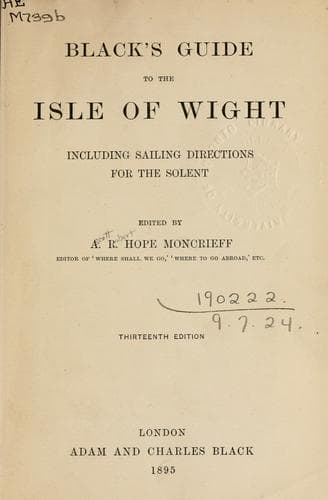
Isle of WightMoncrieff, A. R. Hope (Ascott Robert Hope)
History
Isle of Wight
Moncrieff, A. R. Hope (Ascott Robert Hope)
Isle of Wight (England) -- Description and travel
By Parkhurst there is a pleasant way to Gurnard Bay, the nearest
bathing-place on the coast. Cowes, under half a dozen miles off, may be
gained by roads on either side the river, or by boat when the tide
serves. The well-shod and wary explorer might trace the Medina upwards
through the Downs, and among the peaty bogs of the “Wilderness” on to
its obscure source behind the Undercliff. On either side the “quarried
downs of Wight” offer fine airy walks with valley villages for goal, or
such points as the ancient British settlement, whose pit dwellings may
be traced by an antiquary’s eye in the hollow below Rowborough Downs,
near the road leading south from Carisbrooke. On the other side of the
Medina, by St George’s Down, is mounted the ridge of chalk stretching to
Brading and Bembridge.
In fact Newport, too much neglected by tourists, unless as a
halting-place, would make an excellent station for visiting the whole
Island. I must be content with taking the reader on by the central
railway to the Undercliff. This goes out from Newport with the line to
Sandown, threading the Downs into the Yar Valley; then at Merston
Junction it turns off towards the southern heights swelling up beyond
Godshill station. But one must not forget to mention Shide, on the
outskirts of Newport, not only as a station for its golf-links on Pan
Down, but as a spot in wider touch with the world than any other on the
Island, for here Dr John Milne, F.R.S., has his Seismological
Observatory, if that be a fit title for an installation of instruments
by which earthquakes, thousands of miles away, are recorded long before
they get into newspapers--some indeed that never get into further
notice, spending their force at the bottom of the sea or in wildernesses
beyond the ken of “our own correspondent.”
Godshill is one of the prettiest of the Island villages, claiming its
name from that oft-told legend of supernatural interference with the
building of a church, which by miraculous power was moved to its present
site on an eminence, where it holds up its tower as a conspicuous
landmark. This church is often visited both for the prospect from it,
and for its architectural merits and interesting memorials. Besides a
sixteenth century altar tomb of Sir John Leigh and monuments of the
Worsley family, it contains a specimen of their once famous art
collection in a picture of _Daniel in the Lion’s Den_, said to be in
part by Rubens, or at least after his style. An older patron is recorded
by a tablet praising one of the benefactors of the Newport Grammar
School.
Here lies the mortal part of Richard Gard,
While his freed spirit meets with heaven’s reward;
His gifts endowed the schools, the needy raised
And by the latest memory will be praised.
And may our Isle be filled with such a name,
And be like him whom virtue clothed with fame;
Blessed with the poor, the scholars too were blest
Through such a donor that is gone to rest.
Public-domain text, read in full here on John Shaqi.
Reviews
Reviews
No reviews yet
Be the first to share your thoughts on this work.
Join the Discussion
Join the discussion
Sign in to leave a comment or review.
Sign InorCreate an account