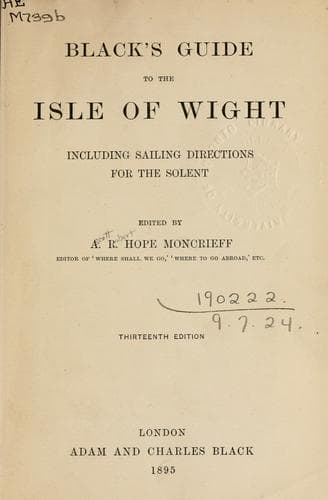
Isle of WightMoncrieff, A. R. Hope (Ascott Robert Hope)
History
Isle of Wight
Moncrieff, A. R. Hope (Ascott Robert Hope)
Isle of Wight (England) -- Description and travel
The more direct route from Ryde to Ventnor is by road, rail, or boat
along the east coast. From the Newport line diverges the old Ventnor
railway, at Brading sending off a branchlet for Bembridge, then holding
on behind Sandown and Shanklin. Thus on this side are strung together
the oldest and one of the youngest settlements of the Isle of Wight.
Brading, an hour’s walk from Ryde, seems an insignificant place now; but
it claims to have been the ancient metropolis of the Island in days when
St Helens was its chief port. Brading Harbour, still a tidal creek that
at high water dignifies the landscape, once made a wider and deeper
gulf, which guide-books of a century back describe as an inland lake set
in woods. Time was, says Sir John Oglander, that boats came up to the
middle of Brading Street, and in the haven below there would be choice
of twenty good shipmasters to undertake any voyage. Then the harbour
having become choked by unwholesome marshes, an attempt was made to
embank them, in which work Sir Hugh Middleton of New River fame had a
hand, and certain “ignorant Dutchmen” were brought over to put in
practice the art to which they owed their own native soil. But the
Dutchmen’s dykes broke down; and the land was not thoroughly reclaimed
till our own time saw the enterprise accomplished by that “Liberator”
Company of else evil renown.
Thus Brading came to be gradually stranded some mile or two inland. The
townlet, that once sent two members to Parliament, has relics to show of
its old dignity, its bull ring, its stocks, and its Norman Church, rich
in monuments, notably the Oglander Chapel enshrining tombs of a family
settled at Nunwell on Brading Down for many centuries, among them the
effigy of that Sir John Oglander, whose memoranda have been so much
drawn on by later writers. He tells how then “many score” of Oglanders
lay in this oldest church of the Island, where the latest addition to
the family chapel is a fine monument to his descendant of the Victorian
age.
The churchyard contains more than one celebrated epitaph, such as that
set to music by Dr Calcott--
Forgive, blest shade, the tributary tear!
and another on a child--
This lovely bud, so young, so fair,
Called hence by early doom,
Just came to show how sweet a flower
In Paradise would bloom.
Public-domain text, read in full here on John Shaqi.
Reviews
Reviews
No reviews yet
Be the first to share your thoughts on this work.
Join the Discussion
Join the discussion
Sign in to leave a comment or review.
Sign InorCreate an account