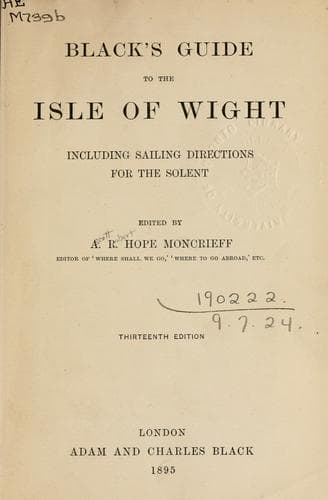
Isle of WightMoncrieff, A. R. Hope (Ascott Robert Hope)
History
Isle of Wight
Moncrieff, A. R. Hope (Ascott Robert Hope)
Isle of Wight (England) -- Description and travel
Here was buried “Jane the young Cottager,” whose humble name has been
spread far by Legh Richmond, curate of this parish at the end of the
eighteenth century. It is to be feared that his writings are not so well
known to our generation as they once were in the religious world, for he
belonged to that school of Evangelical saints, who dwelt more on “Gospel
truths” than on “sound Church feeling”; and his long-spun deathbed
scenes are hardly to the taste of readers who have learned to look for
more piquant flavours in the literature of edification. But in the Isle
of Wight, where Protestantism puts down its foot the more firmly for
recent Catholic invasion, this kindly pastor’s “Annals of the Poor”
still seem to find a sale, as they once did in many languages. Mr
Boucher James goes so far as to say that “in a small way Legh Richmond
did for the Isle of Wight what Walter Scott did for the Scottish
Highlands,” by drawing tourists to seek out the scenes of his tracts. At
all events he deserves the brass now placed to his memory in Brading
Church.[2]
The much restored Church claims to represent that first erected on the
same site by Wilfred, apostle of the Island. But another lion of Brading
is older than its church, though unknown to Legh Richmond’s generation.
This is the Roman villa, discovered a generation ago by Mr Hilton Price,
Director of the Society of Antiquaries, which boasts itself to be the
finest of such miniature Pompeiis in England. It stands about a mile to
the south-west, near Yarbridge, the way being easily found, since
direction posts are never wanting in the Isle of Wight where there is
anything to pay for admission; and the tarred sheds that protect the
remains stand conspicuous against a chalk cutting on the Downs. A score
or so apartments have been unearthed, in some of which were found many
relics of the Roman occupation, the most interesting part of the show
being the tesselated pavements with their mosaic designs. There appear
traces of two successive ownerships, and of the villa having been
destroyed by fire, perhaps on the evacuation of Britain by the Roman
troops. The complete building seems to have been composed of the
_Urbana_, or master’s dwelling, the _Rustica_, or quarters for
dependents, and the _Fructuaria_, store-houses and offices, arranged on
three sides of a rectangle.
Public-domain text, read in full here on John Shaqi.
Reviews
Reviews
No reviews yet
Be the first to share your thoughts on this work.
Join the Discussion
Join the discussion
Sign in to leave a comment or review.
Sign InorCreate an account