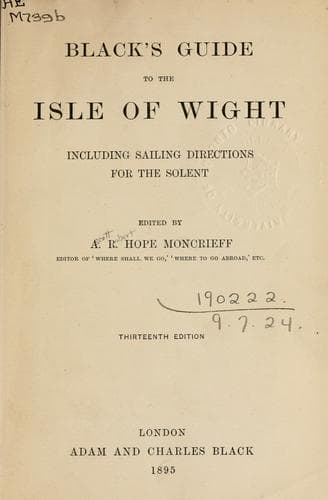
Isle of WightMoncrieff, A. R. Hope (Ascott Robert Hope)
History
Isle of Wight
Moncrieff, A. R. Hope (Ascott Robert Hope)
Isle of Wight (England) -- Description and travel
Shanklin and Sandown, the most growing resorts of the Island of late
years, love one another like Liverpool and Manchester, like Ramsgate and
Margate, like St Paul’s and Minneapolis, and other pairs of too near
rivals for popularity. Careful parents may prefer Sandown as a place
where their youngsters will find nothing to fall off; but poetic and
artistic souls will give their vote for Shanklin, which has chalybeate
springs and elaborate baths as attraction, as well as beautiful
surroundings. Its beauty spot _par excellence_ is, of course, the Chine
above mentioned, which makes one of the shows of the Island. The
Chines, so named here and on the opposite mainland coast--but in one
part of Hampshire _Bunny_ is a less romantic title for them--are deep,
irregular ravines carved out by streams of water upon cliffs of soft
clay or sand, often sheltering a profusion of tangled vegetation, or
again, as at Bournemouth, revealing the frame of naked nature. The
Shanklin Chine, in the former variety, is by many judged the prettiest,
as it is perhaps the best known to visitors. A description of it may be
borrowed from Black’s _Guide to the Isle of Wight_.
This popular sight, like other wonders of nature on the Island, is
enclosed, a small charge being made for admission, and in more than
one respect rather suggests the tea-garden order of resort, but
nothing can spoil it. It is to be entered at either end, but
excursion coaches usually bring their passengers to the head of the
Chine. At the top will be found a ferruginous spring. Here the
chasm is at its narrowest, increasing till it has a breadth of
nearly 300 feet, while the steep sides are in parts almost 200 feet
high. Winding walks take one for some quarter of a mile down a deep
glen, which differs notably from Blackgang Chine in being choked up
with trees and a rich undergrowth of ferns, moss, and brushwood,
wherever any shade-loving plant can take root. Into the top pours a
little waterfall, rushing to the sea at the bottom of this
wilderness of greenery.
But even without its Chine, Shanklin would have a right to be proud of
itself. It lies at the corner of the southern range of Downs that
separate it from Ventnor and the Undercliff. Open and airy walks may be
taken on these heights; or less arduous strolls by the leafy knolls and
hollows on their flanks. One favourite ramble is to Cook’s Castle, an
artificial ruin
[Illustration: SHANKLIN CHINE]
upon a wooded brow commanding a fine view, whence it is a short mile to
Wroxall, the next station on the railway as it bends inland, to find
nothing for it but a tunnel through the heights that shelter Ventnor.
Public-domain text, read in full here on John Shaqi.
Reviews
Reviews
No reviews yet
Be the first to share your thoughts on this work.
Join the Discussion
Join the discussion
Sign in to leave a comment or review.
Sign InorCreate an account